PubChem CID · CC0
formic acid
Research associations
Literature-derived · peer-reviewed sources only · not medical advice
Foods containing this compound

Mentha arvensis (Field Mint, Wild Mint or Corn Mint) is a species of mint with a circumboreal distribution. It is native to the temperate regions of Europe and western and central Asia, east to the Himalaya and eastern Siberia, and North America. It is a herbaceous perennial plant growing to 10–60 cm (rarely to 100 cm) tall. The leaves are in opposite pairs, simple, 2–6.5 cm long and 1–2 cm broad, hairy, and with a coarsely serrated margin. The flowers are pale purple (occasionally white or pink), in clusters on the stem, each flower 3–4 mm long. Uses & Benefits of Podina: 50x40pxThis article does not cite any references or sources. Please help improve this article by adding citations to reliable sources. Unsourced material may be challenged and removed. Podina is used as a carminative and an expectorant. The plant is highly effective in treating headaches, rhinitis, cough sore throat, colic, prurigo and vomiting. It serves as a good blood cleanser, since it is antiseptic and anti-bacterial. Podina plays a significant role in alleviating swollen gums, mouth ulcers and toothaches. Crushed and bruised pudina leaves are used in treating insect bites. The decoction and infusion of its leaves and stems helps in fever, stomachaches, dysmenorrheal and diuresis. Fresh leaves of podina are crushed and sniffed for dizziness. Crushed leaves are also applied on the forehead and temple, to cure headaches. For toothaches, boil 6 tablespoons of pudina leaves in 2 glasses of water, for 15 minutes. Strain and cool the water. Divide it into two parts and take each part after 3 to 4 hours. Boil 6 tablespoons of chopped leaves in 2 glasses of water, for 15 minutes. Cool and strain. Divide the decoction into 3 parts and consume three times a day. This will help in treating coughs. For treating arthritis, take some fresh leaves and heat on low flame. Pound them and apply on the painful joints or muscles, when still warm. Soak 2 tablespoons of chopped leaves in a glass of hot water for 30 minutes and strain. Use the infusion as a mouthwash. The menthol extracted from the plant is used in preparing balms. It is used as a flavoring agent in many culinary preparations There are six subspecies: Mentha arvensis subsp. arvensis. Mentha arvensis subsp. agrestis Briq. Mentha arvensis subsp. austriaca (Jacq. ) Briq. Mentha arvensis subsp. lapponica (Wahlenb. ) Neuman Mentha arvensis subsp. palustris (Moench) Neumann Mentha arvensis subsp. parietariifolia (Becker) Briq. The related species Mentha canadensis is also included in M. arvensis by some authors as two varieties, M. arvensis var. glabrata Fernald (in reference to North American plants) and M. arvensis var. piperascens Malinv. ex L. H. Bailey (in reference to eastern Asian plants).
Rice is the seed of the monocot plants Oryza sativa (Asian rice) or Oryza glaberrima (African rice). As a cereal grain, it is the most widely consumed staple food for a large part of the world's human population, especially in Asia and the West Indies. It is the grain with the second-highest worldwide production, after maize (corn), according to data for 2010. Since a large portion of maize crops are grown for purposes other than human consumption, rice is the most important grain with regard to human nutrition and caloric intake, providing more than one fifth of the calories consumed worldwide by the human species. Genetic evidence has shown that rice originates from a single domestication 8,200–13,500 years ago, in the Pearl River valley region of China. Previously, archaeological evidence had suggested that rice was domesticated in the Yangtze River valley region in China. From East Asia, rice spread to Southeast and South Asia. Rice was introduced to Europe through Western Asia, and to the Americas through European colonization. There are many varieties of rice and culinary preferences tend to vary regionally. In the Far East, there is a preference for softer and stickier varieties. Because of its importance as a staple food, rice has considerable cultural importance. Rice is often directly associated with prosperity and fertility. Therefore, there is the custom of throwing rice at weddings. Rice is normally grown as an annual plant, although in tropical areas it can survive as a perennial and can produce a ratoon crop for up to 30 years. The rice plant can grow to 1–1.8 m tall, occasionally more depending on the variety and soil fertility. It has long, slender leaves 50–100 cm long and 2–2.5 cm broad. The small wind-pollinated flowers are produced in a branched arching to pendulous inflorescence 30–50 cm long. The edible seed is a grain 5–12 mm long and 2–3 mm thick. Rice cultivation is well-suited to countries and regions with low labor costs and high rainfall, as it is labor-intensive to cultivate and requires ample water. Rice can be grown practically anywhere, even on a steep hill or mountain. Although its parent species are native to Asia and certain parts of Africa, centuries of trade and exportation have made it commonplace in many cultures worldwide. The traditional method for cultivating rice is flooding the fields while, or after, setting the young seedlings. This simple method requires sound planning and servicing of the water damming and channeling, but reduces the growth of less robust weed and pest plants that have no submerged growth state, and deters vermin. While flooding is not mandatory for the cultivation of rice, all other methods of irrigation require higher effort in weed and pest control during growth periods and a different approach for fertilizing the soil. The name wild rice is usually used for species of the grass genus Zizania, both wild and domesticated, although the term may also be used for primitive or uncultivated varieties of Oryza.

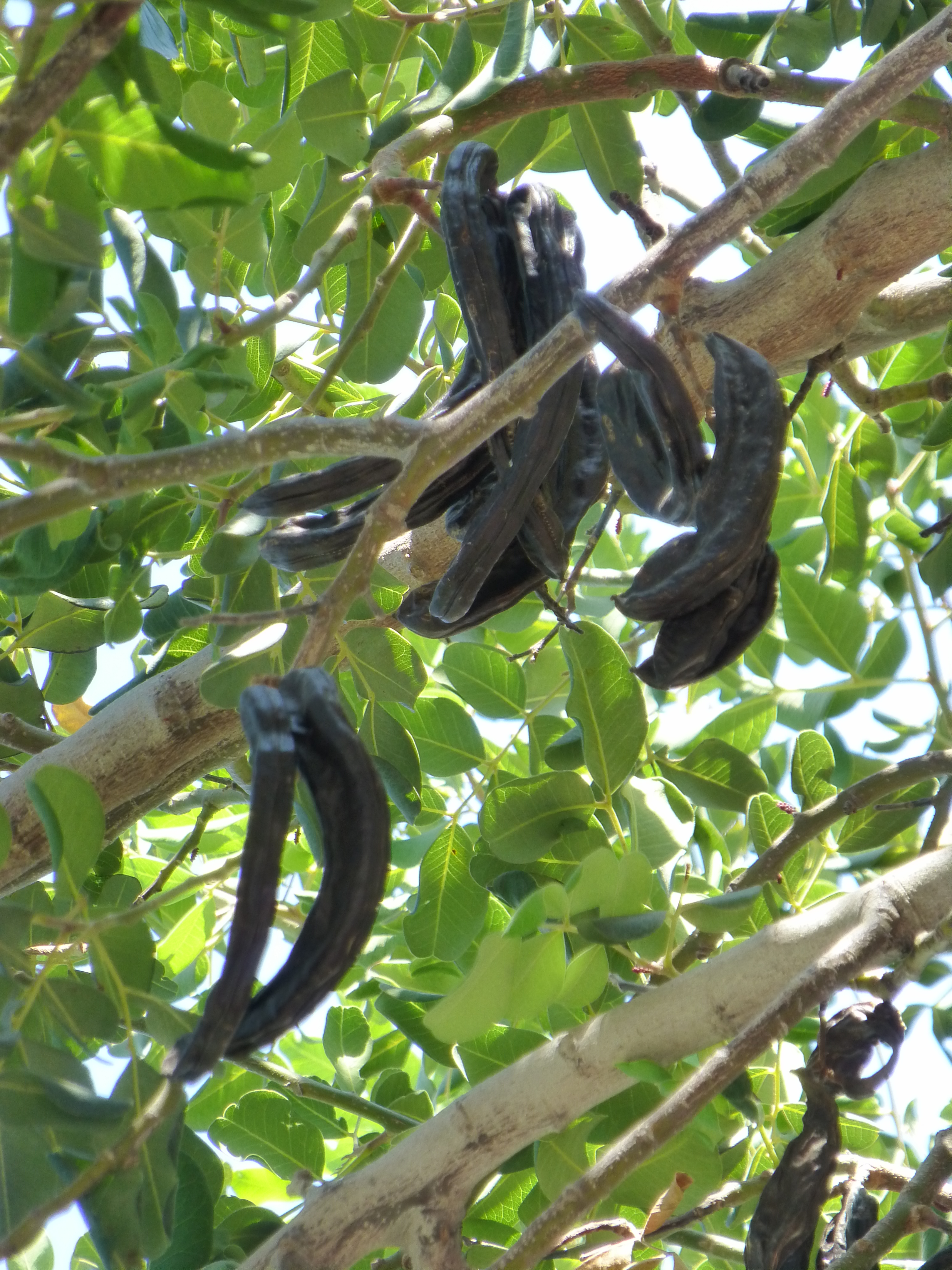
Ceratonia siliqua, commonly known as the carob tree and St John's-bread, is a species of flowering evergreen shrub or tree in the pea family, Fabaceae. It is widely cultivated for its edible pods, and as an ornamental tree in gardens. The ripe, dried pod is often ground to carob powder which is used as a substitute for cocoa powder.

The chicken (Gallus gallus domesticus) is a domesticated fowl, a subspecies of the Red Junglefowl. As one of the most common and widespread domestic animals, with a population of more than 24 billion in 2003, there are more chickens in the world than any other species of bird. Humans keep chickens primarily as a source of food, consuming both their meat and their eggs.
The roselle (Hibiscus sabdariffa) is a species of Hibiscus native to the west Africa, used for the production of bast fibre and as an infusion. It is an annual or perennial herb or woody-based subshrub, growing to 2?2.5 m (7?8 ft) tall. The leaves are deeply three- to five-lobed, 8?15 cm (3?6 in) long, arranged alternately on the stems.
Laurus nobilis is an aromatic evergreen tree or large shrub with green, glossy leaves, native to the Mediterranean region. It is one of the plants used for bay leaf seasoning in cooking. It is known as bay laurel, sweet bay, bay tree (esp. United Kingdom), true laurel, Grecian laurel, laurel tree or simply laurel. Laurus nobilis figures prominently in classical Greek, Roman, and Biblical culture.


cocktail
type of cacao product originated by the Indigenous peoples of South America

Species of flowering plant

Aromatic resin from the Commiphora myrrha tree
Source
Compound data linked to PubChem CID 284, public domain via NCBI. Culinary context + ingredient mappings are maintained by Foodgeist's enrichment fleet and continuously re-matched by the pairings engine. PubChem CID 284