Ingredient
Curdled milk food product
As an Amazon Associate, Foodgeist earns from qualifying purchases.
Stainless press for hard cheeses — cheddar, gouda, manchego
Bamboo mats for air circulation during cheese aging
Ceramic fondue pot with burner — cheese and chocolate fondue
Reusable food wraps — cheese storage, bread wrapping, bowl covering
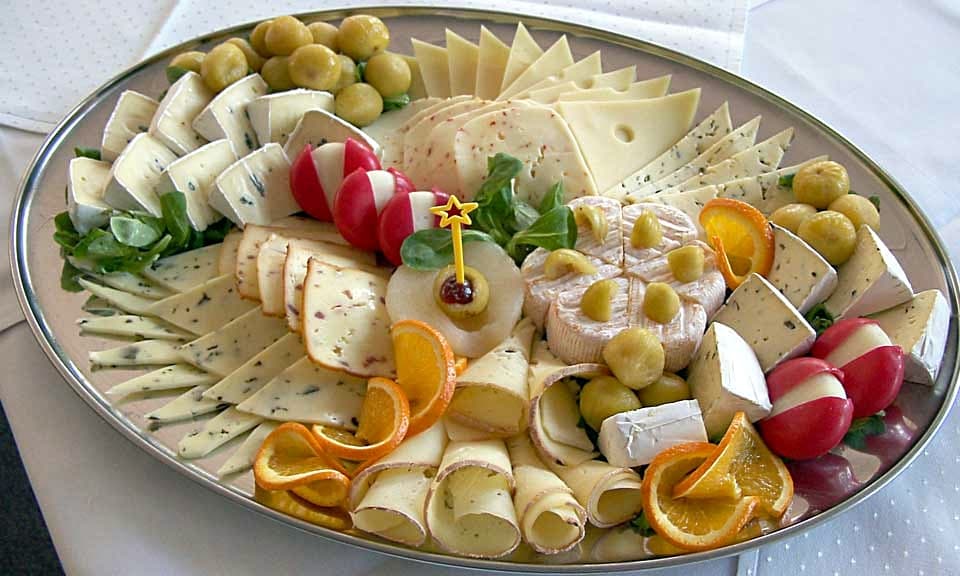
Cheese is a type of dairy product produced in a range of flavors, textures, and forms by coagulation of the milk protein casein. It is composed of proteins and fat from milk, usually of cows, goats or sheep, and sometimes of water buffalo. During production, milk is usually acidified and either the enzymes of rennet or bacterial enzymes with similar activity are added to cause the casein to coagulate. The solid curds are then separated from the liquid whey and pressed into finished cheese. Some cheeses have aromatic molds on the rind, the outer layer, or throughout.
O124 Escherichia coli → isolated from → cheese and stools of nine ill individuals
“An O124 Escherichia coli was isolated from the cheese and from the stools of nine ill individuals.”
unpasteurized soft cheese → linked to → Salmonella berta outbreak
“The investigation linked illness to consumption of an unpasteurized soft cheese product produced on a farm and sold at farmers' markets.”
potentially pathogenic bacteria → survive → Swiss hard and semihard cheeses
“The results show that hard cheeses are hygienically safe; 1 wk after fabrication, the inoculated pathogens (Aeromonas hydrophila. Campylobacter jejuni, Escherichia coli, Listeria monocytogenes, Pseudomonas aeruginosa, Salmonella spp., Staphylococcus aureus, and Yersinia enterocolitica) could no longer be detected.”
raw milk and soft cheese → presented → high counts of mesophilic aerobes, total coliforms, and LAB
“The samples presented high counts of mesophilic aerobes, total coliforms, and LAB”
raw milk and soft cheese → observed → low levels of CPS and E. coli
“Low levels of CPS and E. coli were observed”
raw milk and soft cheese → absence of → Salmonella spp. and L. monocytogenes
“an absence of Salmonella spp. and L. monocytogenes”
potentially pathogenic bacteria → survive → Swiss semihard cheeses
“At the age of commercial ripeness, the semihard cheeses were free from the inoculated pathogens and their toxic metabolites, except for L. monocytogenes, which survived the manufacturing and ripening process.”
Staphylococcus aureus → can grow and produce enterotoxin A → during Camembert-type cheese production
“The level of staphylococcal enterotoxin A recovered varied from 1 to 3.2 ng g-1 of cheese made with an initial population of 10(3)-10(6) cfu ml-1”
soy cream cheeses → are stable against → syneresis and oil separation
“They were also stable against syneresis and oil separation over storage of 20 days”
nisin → improves → Minas Frescal cheese safety
“Nisin showed potential to be used as an additional, important hurdle to improve Minas Frescal cheese safety, without replacing good manufacturing practices.”
Based on 11 papers
Based on 8 papers
Based on 3 papers
Based on 3 papers
Based on 3 papers
Based on 3 papers
Based on 2 papers
Based on 2 papers
Based on 2 papers
Based on 2 papers
Based on 2 papers
Based on 2 papers
Based on 2 papers
“String cheese samples ranging in pH from 5.0 to 5.9 were prepared by kneading Mozzarella curd and stretching it 2 to 80 times. Rheological properties were examined by compression, stress relaxation, and flow property tests.”
string cheese → affects → rheological properties
“After 270 days of maturation at 8 °C, the full-fat full-salt cheese had lower concentrations of lactic acid”
full-fat full-salt cheese → had lower concentrations of → lactic acid
“After 270 days of maturation at 8 °C, the full-fat full-salt cheese had lower concentrations of free amino acids”
full-fat full-salt cheese → had lower concentrations of → free amino acids
“After 270 days of maturation at 8 °C, the full-fat full-salt cheese had a higher lactic acid-to-protein ratio”
full-fat full-salt cheese → had a higher → lactic acid-to-protein ratio
“Cheddar cheeses ranged from 8.2% fat and 51.1% moisture in the 75% low-fat product to 33.2% fat and 35.9% moisture in the full-fat cheese.”
Cheddar cheese → ranges in fat content → 8.2% to 33.2%
Foodgeist is developed, created, and maintained by one food geek. It gets lonely. It gets expensive. Say hi →
Foodgeist is a participant in the Amazon Services LLC Associates Program, an affiliate advertising program designed to provide a means for sites to earn advertising fees by advertising and linking to Amazon.com. As an Amazon Associate we earn from qualifying purchases.