About
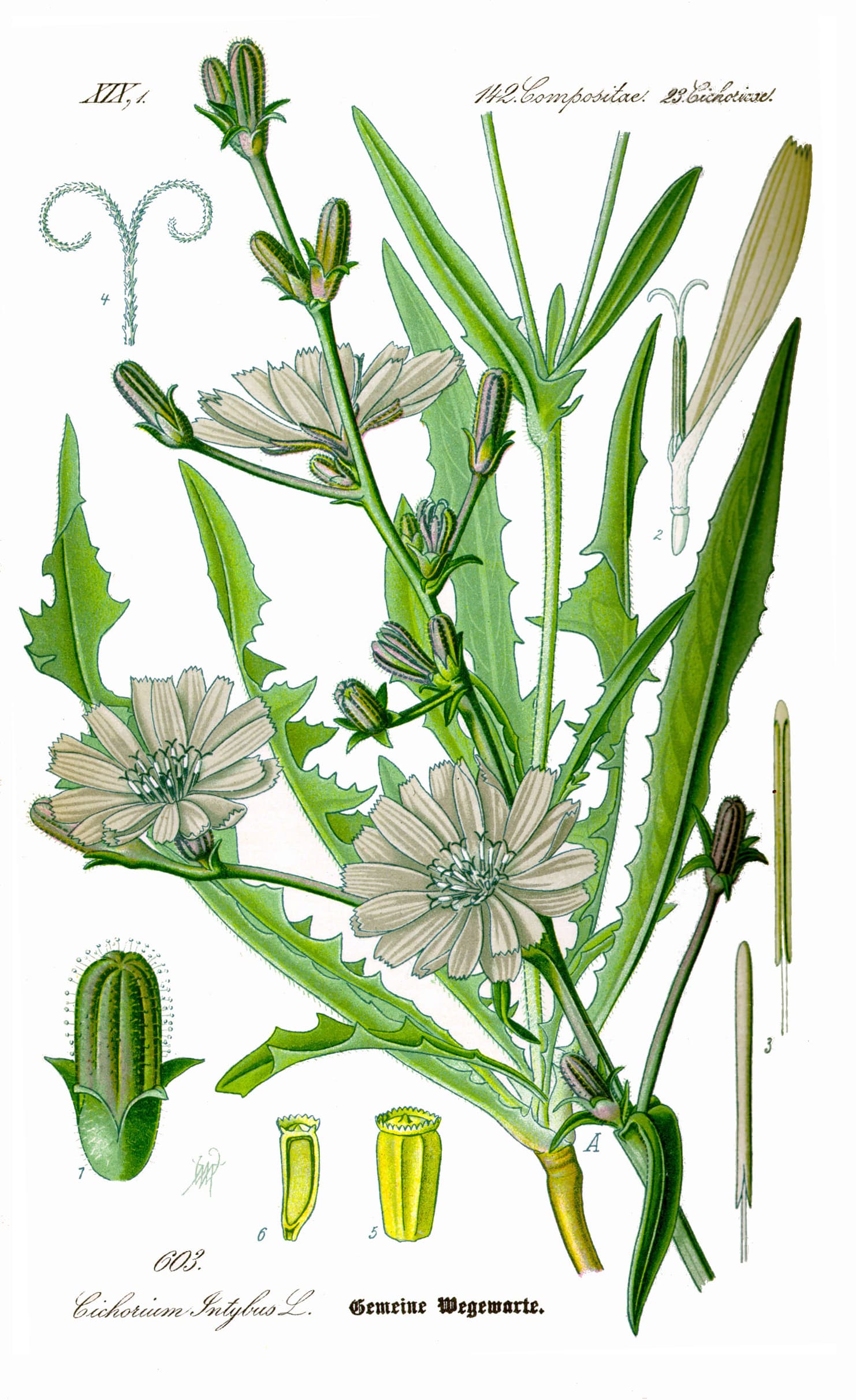
Common chicory is a somewhat woody, perennial herbaceous plant of the family Asteraceae, usually with bright blue flowers, rarely white or pink. Native to Europe, North Africa, and western Asia, it has been introduced to the Americas and Australia.
Aroma profile
Derived from this ingredient’s flavor compounds
sharp×16
sickening×15
nutty×15
ethereal×15
pungent×14
floral×13
caramel×13
almond×14
Taste profile
Derived from this ingredient's compounds · measured taste classes
bittersweetsourumami
Composition
60 compounds identified — cross-referenced scientific databases
(+)-delta-Cadinene(+)-Neomenthol(Z)-cinnamyl alcohol1-Pyrroline2-(4-Hydroxyphenyl)ethanol2-Acetylpyrrole2-Butanone2-Ethyl-4-hydroxy-5-methyl-3(2H)-furanone2-Isopropyl-5-methylcyclohexanone2-Methyl-1-Butanol2-Methylbutyraldehyde2-Phenylethanol2,3-butanedione3-(Methylthio)propionaldehyde3-Hexanone3-Methyl-1-butanol
Molecular affinity
Pairs well with — ingredients that share aroma compounds
Based on shared flavor compounds · click to explore
Commonly combined
Frequently used together in real recipes — ranked by how specifically these ingredients appear together
Research Evidence
Multi-source verifiedVerification: Independently verified
The Geist can be wrong. Some flavor, taste, and pairing values are model-predicted, not lab-measured.