PubChem CID · CC0
hexopyranose
Odor profile
Multi-model odor estimate · confidence shown
Foods containing this compound

Channel catfish, Ictalurus punctatus, is North America's most numerous catfish species. It is the official fish of Missouri, Iowa, Nebraska, Kansas, and Tennessee, and is informally referred to as a "channel cat". In the United States, they are the most fished catfish species with approximately 8 million anglers targeting them per year. The popularity of channel catfish for food has contributed to the rapid growth of aquaculture of this species in the United States.

The eastern oyster (Crassostrea virginica) — also called Atlantic oyster or Virginia oyster — is a species of true oyster native to the eastern seaboard and Gulf of Mexico coast of North America. It is also farmed in Puget Sound, Washington, where it is known as the Totten Inlet Virginica. Eastern oysters are and have been very popular commercially. Today, less than 1% of the original 17th century population (when the original colonists arrived) is thought to remain in the Chesapeake Bay and its tributaries, although population estimates from any era are uncertain. The eastern oyster is the state shellfish of Connecticut, its shell is the state shell of Virginia and Mississippi, and its shell in cabochon form is the state gem of Louisiana.
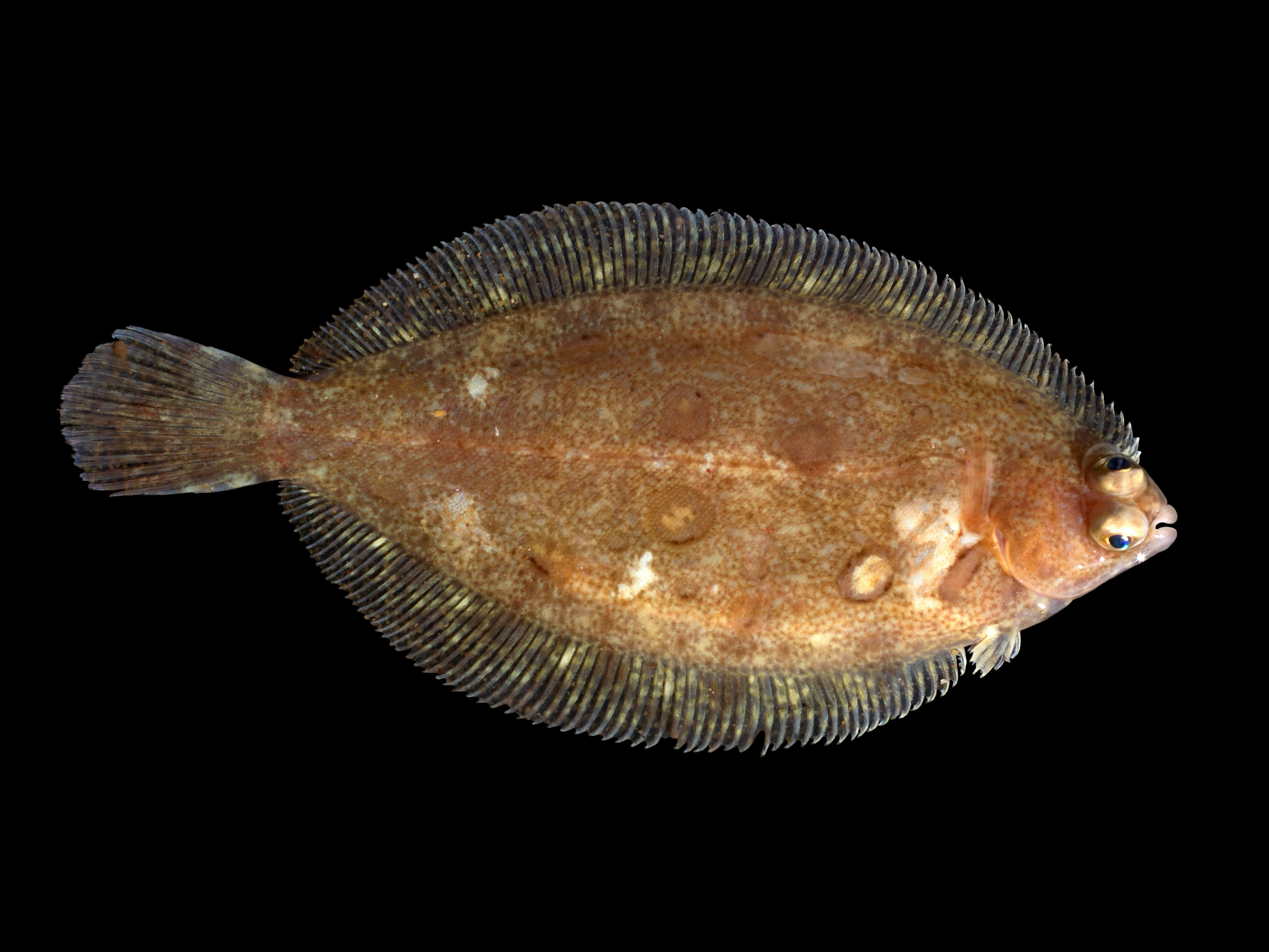
The Greenland halibut or Greenland turbot (Reinhardtius hippoglossoides) belongs to the Pleuronectidae family (the right eye flounders), and is the only species of the genus Reinhardtius. It is a deepwater fish distributed from 200 to 1600 m but has been caught at depths more than 2,200 m . It is mainly found in waters with temperatures from 1-4 °C, but has also observed at sub-zero temperatures down to -2.1 °C. It has a circumpolar distribution and is found in both the Atlantic and the Pacific oceans. Its morphology with the left eye positioned on the dorsal ridge of the forehead gives it an appearance of a cyclops when looking straight at it. The central position of the left eye in the Greenland halibut probably gives it a much wider range of peripheral vision in comparison to other flatfish where the eye has migrated completely. The body shape is elongated and compressed dorsal-ventrally and muscles on both sides are equally developed. Both sides are pigmented; however the left blind side is slightly lighter in color than the right side. Its physical appearance suggests it to be a vigorous swimmer that can swim in a vertical position. Vertical swimming has been observed during tagging experiments. However, video analyzing of Greenland halibut behavior in front of a bottom trawl showed no sign of swimming in a vertical position. Even though most Greenland halibut are caught in bottom fishing gears (trawl, longline and gillnet) they have also been caught in surface drift nets which indicates that they can have a pelagic occurrence. Stomach analysis has also shown that the diet consists mostly of pelagic or bathypelagic organisms. Even though the Greenland halibut is a flatfish it does at times behave more like a roundfish.

The American lobster, Homarus americanus, is a species of lobster found on the Atlantic coast of North America, chiefly from Labrador to New Jersey. Within North America, it is also known as the northern lobster or Maine lobster. It can reach a body length of 64 cm, and a mass of over 20 kilograms, making it the heaviest crustacean in the world. Its closest relative is the European lobster Homarus gammarus, which can be distinguished by its coloration and the lack of spines on the underside of the rostrum. American lobsters are usually bluish green to brown with red spines, but a number of color variations have been observed.

Sebastes is a genus of fish in the family Sebastidae (though some include this in Scorpaenidae), most of which have the common name of rockfish. A few are called ocean perch, sea perch or redfish instead. Most of the Sebastes species live in the north Pacific, although two (S. capensis and S. oculatus) live in the south Pacific/Atlantic and four (S. fasciatus, S. mentella, S. norvegicus and S. viviparus) live in the north Atlantic. The coast off South California is the area of highest rockfish diversity, with 56 species living in the Southern California Bight.
The northern pike (Esox lucius), known simply as a pike in Britain, Ireland, Canada, and most parts of the USA, also called jackfish or simply "northern" in the Upper Midwest of the USA), is a species of carnivorous fish of the genus Esox (the pikes). They are typical of brackish and fresh waters of the Northern Hemisphere (i.e. holarctic in distribution). Pike grow to a relatively large size; lengths of 150 cm (59 in) and weights of 25 kg (55 lb) are not rare. The average length is about 70-120 cm (28-47 in). The heaviest specimen known so far was caught in 1983 at an abandoned stone quarry in Germany, where the species is known as a Hecht. She (the majority of all pikes over 8 kg or 18 lb are females) was 147 cm (58 in) long and weighed 31 kg (68 lb). The longest pike ever recorded and confirmed was 152 cm (60 in) long and weighed 28 kg (62 lb). A pike of 60.5 in (154 cm) was caught and released in May 2004 in Apisko Lake, Manitoba. Historic reports of giant pike, caught in nets in Ireland in the late 19th century, of 41-42 kg (90-93 lb) with a length of 173-175 cm (67-68 in), were researched by Fred Buller and published in The Domesday Book of Mammoth Pike.
The chum salmon (Oncorhynchus keta) is a species of anadromous fish in the salmon family. It is a Pacific salmon, and may also be known as dog salmon or Keta salmon, and is often marketed under the name Silverbrite salmon. The name Chum salmon comes from the Chinook Jargon term tzum, meaning "spotted" or "marked", while "Keta" comes from the Evenki language of Eastern Siberia via Russian.

The coho salmon, Oncorhynchus kisutch (from the Russian ????? kizhuch), is a species of anadromous fish in the salmon family. Coho salmon are also known as silver salmon or "silvers".
Sockeye salmon (Oncorhynchus nerka) ? also called red salmon or blueback salmon in the United States ? is an anadromous species of salmon found in the Northern Pacific Ocean and rivers discharging into it. This species is a Pacific salmon that is primarily red in hue during spawning. They can be up to 84 cm in length and weigh anywhere from 2.3 to 7 kg. A distinguishing feature of the sockeye salmon is the lack of a definite spot on the back and tail. Juveniles remain in freshwater until they are ready to migrate to the ocean, over distances of up to 1,600 km. Their diet consists primarily of zooplankton. Sockeye salmon are semelparous, dying after they spawn.
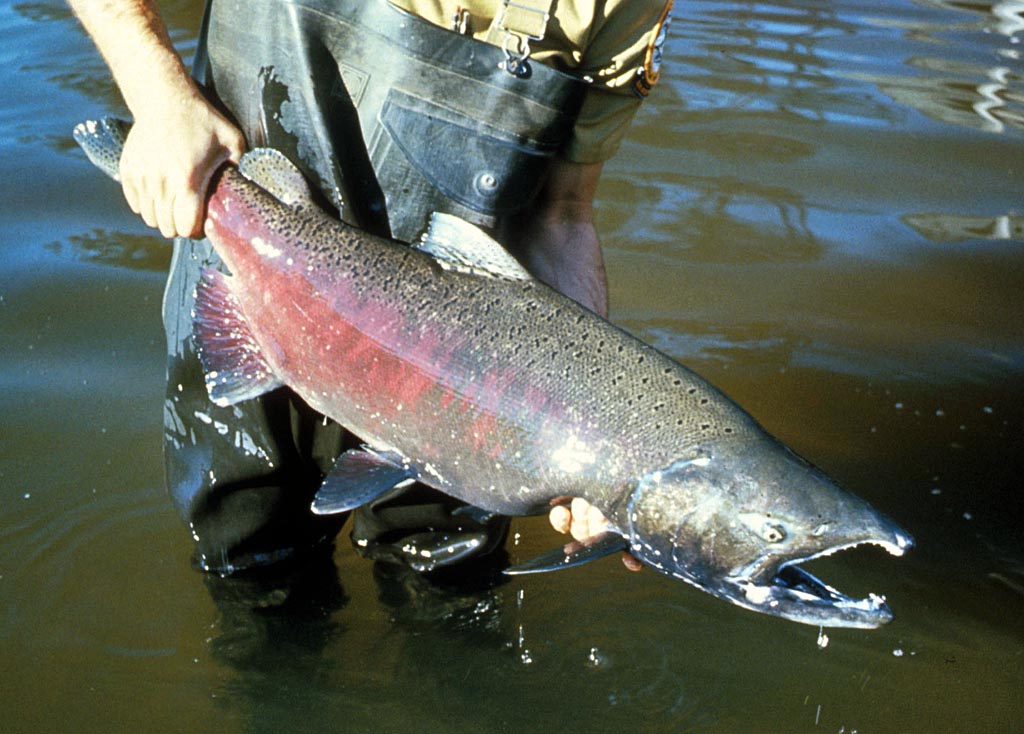
The Chinook salmon, Oncorhynchus tshawytscha, is the largest species in the Pacific (Oncorhynchus) salmon family. Other commonly used names for the species include king salmon, Quinnat salmon, spring salmon and Tyee salmon. Chinook are anadromous fish native to the north Pacific Ocean and the river systems of western North America ranging from California to Alaska. They are also native to Asian rivers ranging from northern Japan to the Palyavaam River in the Siberian far east, although only the Kamchatka Peninsula supports relatively persistent native populations. They have been introduced to other parts of the world, including New Zealand and the Great Lakes. A large Chinook is a prized and sought-after catch for a sporting angler. The flesh of the salmon is also highly valued for its dietary nutritional content, which includes high levels of important omega-3 fatty acids. Some populations are endangered, though Chinook salmon have not been assessed for the IUCN Red List.
A scallop (from Old French escalope, meaning "shell") is a common name applied to many species of marine bivalve mollusks in the family Pectinidae, the scallops. Scallops are a cosmopolitan family, found in all of the world's oceans.
Salmonidae are a family of ray-finned fish, the only living family currently placed in the order Salmoniformes. It includes salmon, trout, chars, freshwater whitefishes and graylings. The Atlantic salmon and trout of genus Salmo give the family and order their names. Salmonids have a relatively primitive appearance among the teleost fish, with the pelvic fins being placed far back, and an adipose fin towards the rear of the back. They are slender fish, with rounded scales and forked tails. Their mouths contain a single row of sharp teeth. Although the smallest species is just 13 centimetres long as an adult, most are much larger, and the largest can reach 2 metres . All salmonids spawn in fresh water, but in many cases, the fish spend most of their lives at sea, returning to the rivers only to reproduce. This life cycle is described as anadromous. They are predators, feeding on small crustaceans, aquatic insects, and smaller fish.

Alaska pollock or walleye pollock (Theragra chalcogramma) is a species of the cod family Gadidae. Alaska pollock is a semipelagic schooling fish widely distributed in the North Pacific with largest concentrations found in the eastern Bering Sea. While related to the common Atlantic pollock species of the same family, the Alaska pollock is not a member of the same Pollachius genus. Rather, recent research suggests that it is more closely related to Atlantic cod, and that Alaska pollock should be moved back to genus Gadus in which it was originally described as Gadus chalcogrammus. Furthermore, Norwegian pollock (Theragra finnmarchica), a rare fish of Norwegian waters, is likely the same species as the Alaska pollock.
Merlangius merlangus, commonly known as whiting, is an important food fish in the eastern North Atlantic Ocean and the northern Mediterranean, western Baltic, and Black Seas. In English-speaking countries outside the whiting's natural range, the name has been applied to various other species of fish.

Pollock (alternatively spelled pollack) is the common name used for either of the two species of marine fish in the Pollachius ("P.") genus. Both P. pollachius and P. virens are commonly referred to as pollock. Other names for P. pollachius include the Atlantic pollock, European pollock, lieu jaune, and lythe; while P. virens is sometimes known as Boston blues (distinct from bluefish), coalfish (or coley), silver bills or saithe.
Gadus is a genus of demersal fish in the family Gadidae, commonly known as cod, although there are additional cod species in other genera. Until recently, three species in the genus were recognized. Modern taxonomy also includes a fourth one, the Alaska pollock (Gadus chalcogrammus), which is not separate from the Norway pollock. Furthermore, Greenland cod (G. ogac) is no longer considered a distinct species but rather a subspecies of Pacific cod (G. macrocephalus).

Clupeinae is a subfamily of herrings, sardines and sprats belonging to the family Clupeidae.

Perciformes, also called the Percomorphi or Acanthopteri, are the largest order of vertebrates, containing about 40% of all bony fish. Perciformes means "perch-like". They belong to the class of ray-finned fish, and comprise over 10,000 species found in almost all aquatic ecosystems.
Bivalvia is a class of marine and freshwater molluscs that have laterally compressed bodies enclosed by a shell consisting of two hinged parts. They have no head, and they also lack a radula. Bivalves include clams, oysters, cockles, mussels, scallops, and numerous other families that live in saltwater, and well as a number of families that live in freshwater. The majority are filter feeders. The gills have evolved into ctenidia, specialised organs for feeding and breathing. Most bivalves bury themselves in sediment, where they are relatively safe from predation. Others lie on the sea floor or attach themselves to rocks or other hard surfaces. A few bore into wood, clay or stone and live inside these substances. Some bivalves, such as the scallops, can swim.
The term shrimp is used to refer to some decapod crustaceans, although the exact animals covered can vary. Used broadly, it may cover any of the groups with elongated bodies and a primarily swimming mode of locomotion – chiefly Caridea and Dendrobranchiata. In some fields, however, the term is used more narrowly, and may be restricted to Caridea, to smaller species of either group, or to only the marine species. Under the broader definition, shrimp may be synonymous with prawn, covering stalk-eyed swimming crustaceans with long narrow muscular tails, long whiskers and slender legs. They swim forwards by paddling with swimmerets on the underside of their abdomens. Crabs and lobsters have strong walking legs, whereas shrimp have thin fragile legs which they use primarily for perching. Shrimp are widespread and abundant. They can be found feeding near the seafloor on most coasts and estuaries, as well as in rivers and lakes. To escape predators, some species flip off the seafloor and dive into the sediment. They usually live from one to seven years. Shrimp are often solitary, though they can form large schools during the spawning season. There are thousands of species, and usually there is a species adapted to any particular habitat. Any small crustacean which resembles a shrimp tends to be called one. They play important roles in the food chain and are important food sources for larger animals from fish to whales. The muscular tails of shrimp can be delicious to eat, and they are widely caught and farmed for human consumption. Commercial shrimp species support an industry worth 50 billion dollars a year, and in 2010 the total commercial production of shrimp was nearly 7 million tonnes (see production chart on the right). Shrimp farming took off during the 1980s, particularly in China, and by 2007 the harvest from shrimp farms exceeded the capture of wild shrimp. There are significant issues with excessive bycatch when shrimp are captured in the wild, and with pollution damage done to estuaries when they are used to support shrimp farming. Many shrimp species are small as the term shrimp suggests, about 2 cm long, but some shrimp exceed 25 cm . Larger shrimp are more likely to be targeted commercially, and are often referred to as prawns, particularly in Britain.
Coffee is a brewed beverage prepared from the roasted or baked seeds of several species of an evergreen shrub of the genus Coffea. The two most common sources of coffee beans are the highly regarded Coffea arabica, and the "robusta" form of the hardier Coffea canephora. The latter is resistant to the coffee leaf rust (Hemileia vastatrix), but has a more bitter taste. Coffee plants are cultivated in more than 70 countries, primarily in equatorial Latin America, Southeast Asia, and Africa. Once ripe, coffee "berries" are picked, processed and dried to yield the seeds inside. The seeds are then roasted to varying degrees, depending on the desired flavor, before being ground and brewed to create coffee.


Frozen dessert is the generic name for desserts made by freezing liquids, semi-solids, and sometimes even solids. They may be based on flavored water (shave ice, sorbet, snow cones, etc.), on fruit purées (such as sorbet), on milk and cream (most ice creams), on custard (frozen custard and some ice creams), on mousse (semifreddo), and others.

A pancake is a thin, flat, round cake prepared from a batter, and cooked on a hot griddle or frying pan. Most pancakes are quick breads; some use a yeast-raised or fermented batter. Most pancakes are cooked one side on a griddle and flipped partway through to cook the other side. Depending on the region, pancakes may be served at any time, with a variety of toppings or fillings including jam, chocolate chips, fruit, syrup or meat. [Wikipedia]
A spread is a food that is spread with a knife onto bread, crackers, or other bread products. Spreads are added to bread products to provide flavor and texture, and are an integral part of the dish, i.e. they should be distinguished from condiments, which are optional additions. Spreads should also be distinguished from dips, which do not employ a knife in applying it to crackers or chips, such as salsa. [Wikipedia]

An energy drink is a type of beverage containing stimulant drugs, chiefly caffeine, which is marketed as providing mental or physical stimulation. There are myriad brands and varieties of energy drinks. They generally contain large amounts of caffeine and other stimulants. Many also contain sugar or other sweeteners, herbal extracts and amino acids and may or may not be carbonated. They are a subset of the larger group of energy products, which includes bars and gels. Coffee, tea and other naturally caffeinated beverages are usually not considered energy drinks. Soft drinks such as cola, may contain caffeine, but are also not energy drinks. Some alcoholic beverages, such as Four Loko, contain caffeine and other stimulants and are marketed as energy drinks, although such drinks are banned in some American states.

Macaroni and cheese, also known as "mac and cheese", "macaroni cheese" in British English, or "macaroni pie" in Caribbean English, is a casserole consisting of cooked elbow macaroni and cheese sauce. Macaroni and cheese is often prepared using a packaged food mix. [Wikipedia]

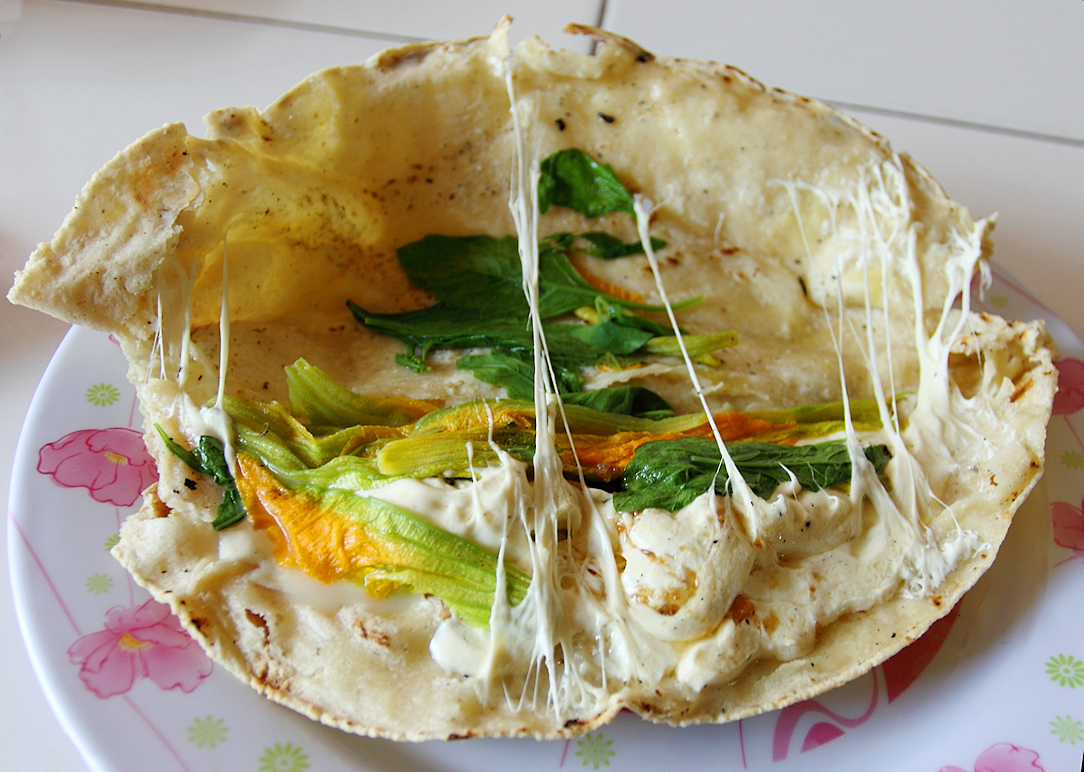
Vegetarian cuisine refers to food that meets vegetarian standards by not including meat and animal tissue products. For lacto-ovo vegetarianism (the most common type of vegetarianism in the Western world), eggs and dairy products such as milk and cheese are permitted. For lacto vegetarianism, the earliest known type of vegetarianism, dairy products such as milk and cheese are permitted. The strictest forms of vegetarianism are veganism and fruitarianism, which exclude all animal products, including dairy products as well as honey, and even some refined sugars if filtered and whitened with bone char. Vegetarian foods can be classified into several different types: Traditional foods that have always been vegetarian Soy products including tofu and tempeh which are common protein sources Textured vegetable protein (TVP), made from defatted soy flour, often included in chili and burger recipes in place of ground meat Meat analogues, which mimic the taste, texture, and appearance of meat and are often used in recipes that traditionally contained meat. Vegans may also use analogues for eggs and dairy products
French toast or eggy bread is a dish of bread soaked in eggs then fried. Where French toast is served as a sweet dish, milk, sugar, or cinnamon are also commonly added before frying, and it may be then topped with sugar, butter, fruit, syrup, or other items. Where it is a savory dish, it is generally fried with a pinch of salt, and then served with a sauce such as ketchup or mayonnaise. [Wikipedia]
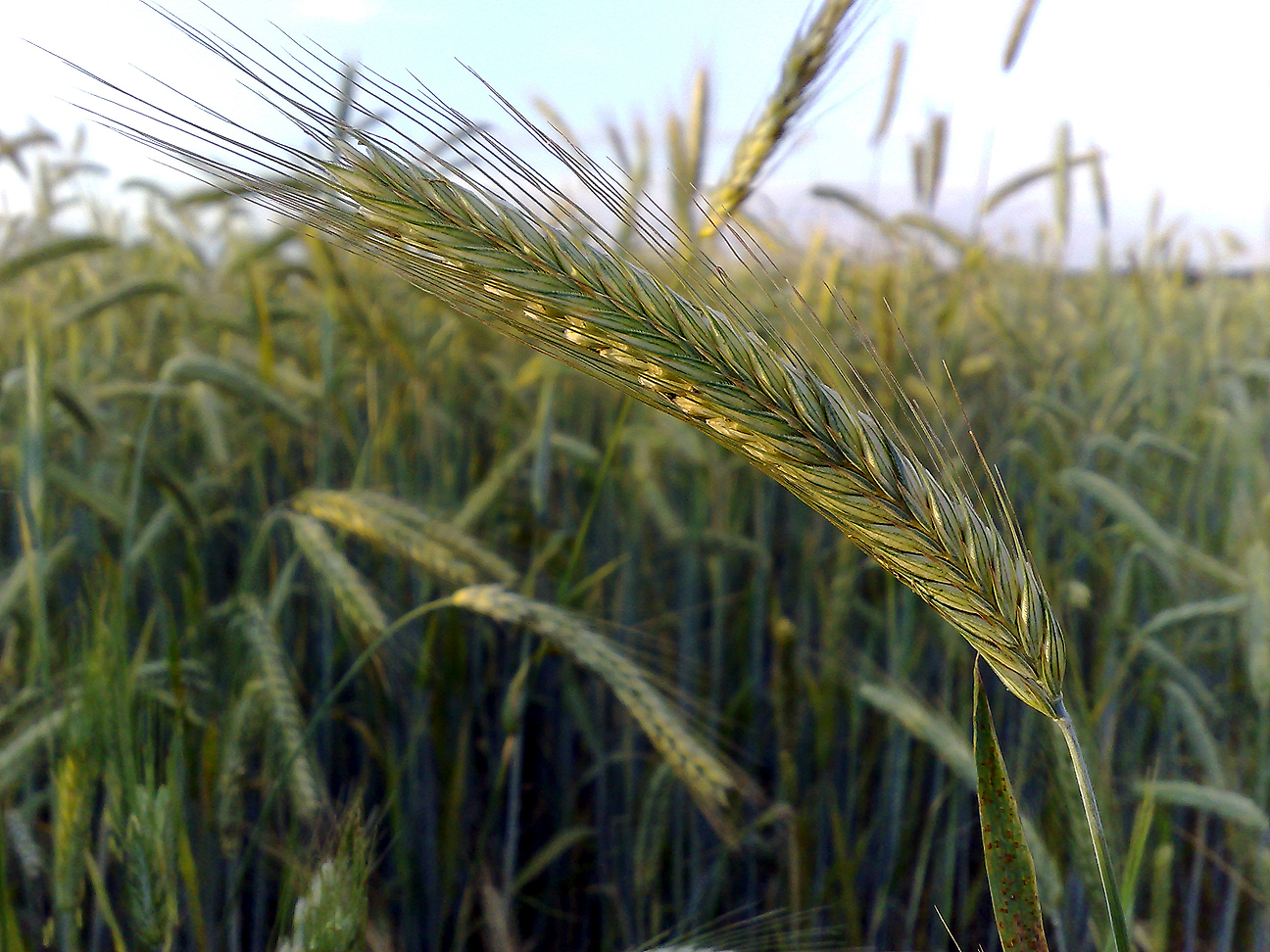
Grits are a food of American Indian origin common in the Southern United States and mainly eaten at breakfast. They consist of coarsely ground corn, or sometimes alkali-treated corn (hominy). They are also sometimes called sofkee or sofkey from the Muskogee (Creek) language word. Grits are similar to other thick maize-based porridges from around the world, such as polenta, or the thinner farina. [Wikipedia]


Horchata is the name of several kinds of traditional beverages, made of ground almonds, sesame seeds, rice, barley, or tigernuts (chufas). [Wikipedia]
A soft drink (also called a soda, pop, coke, soda pop, fizzy drink, tonic, or carbonated beverage) is a non-alcoholic beverage that typically contains water (often, but not always carbonated water), a sweetener, and a flavoring agent. The sweetener may be sugar, high-fructose corn syrup, or a sugar substitute (in the case of diet drinks). A soft drink may also contain caffeine, fruit juice, or both. Widely sold soft drink flavors are cola, lemon-lime, root beer, orange, grape, vanilla, ginger ale, fruit punch, and sparkling lemonade. Soft drinks may be served chilled or at room temperature. They are rarely heated. [Wikipedia]
A milkshake is a sweet, cold beverage which is made from milk, ice cream or iced milk, and flavorings or sweeteners such as fruit syrup or chocolate sauce. Outside the United States, the drink is sometimes called a thick shake or a thick milkshake, to differentiate it from other less-viscous forms of flavored milk. [Wikipedia]
Source
Compound data linked to PubChem CID 206, public domain via NCBI. Culinary context + ingredient mappings are maintained by Foodgeist's enrichment fleet and continuously re-matched by the pairings engine. PubChem CID 206