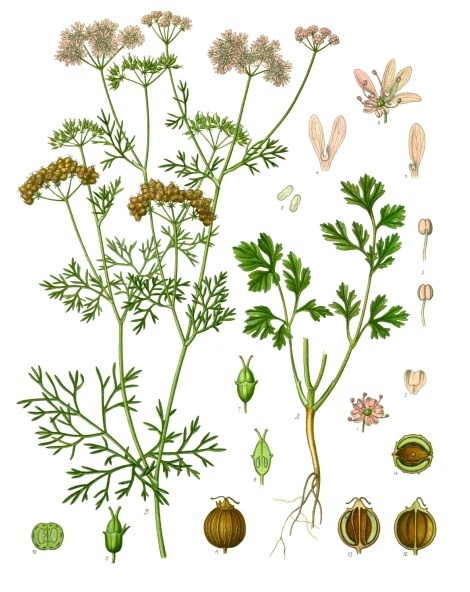
Cook with Coriander
As an Amazon Associate, Foodgeist earns from qualifying purchases.
Flavor compounds
60 compounds identified — FoodAtlas / FooDB verified
Molecular pairings
Pairs well with — computed from shared flavor compounds
Foodgeist is a participant in the Amazon Services LLC Associates Program, an affiliate advertising program designed to provide a means for sites to earn advertising fees by advertising and linking to Amazon.com. As an Amazon Associate we earn from qualifying purchases.
Ingredient
As an Amazon Associate, Foodgeist earns from qualifying purchases.
60 compounds identified — FoodAtlas / FooDB verified
Pairs well with — computed from shared flavor compounds
Highlighted compounds are flavor-active · click to view molecular profile
Based on shared molecular compounds · click to explore
“Linalool (40.9-79.9%), neryl acetate (2.3-14.2%), gamma-terpinene (0.1-13.6%) and alpha-pinene (1.2-7.1%) were identified as main components in the oil of the coriander accessions.”
coriander seeds → contain → linalool
“Linalool (40.9-79.9%), neryl acetate (2.3-14.2%), gamma-terpinene (0.1-13.6%) and alpha-pinene (1.2-7.1%) were identified as main components in the oil of the coriander accessions.”
coriander seeds → contain → alpha-pinene
“The different parts of this plant contain monoterpenes, limpnene, α‐pinene, γ‐terpinene, p‐cymene, citronellol, borneol, camphor, coriandrin, geraniol, dihydrocoriandrin, coriandronsA‐E, flavonoids and essential oils.”
coriander → contains → γ‐terpinene
“Various parts of this plant, such as seeds, leaves, flower and fruit, possess anthelmintic activity”
coriander → has → anthelmintic activity
“In evaluating the antimicrobial potency of coriander oil against C. jejuni on beef and chicken meat at 4 degrees C and 32 degrees C, it was found that the oil reduced the bacterial cell load in a dose-dependent manner.”
coriander oil → reduces → bacterial cell load