Foodgeist is a participant in the Amazon Services LLC Associates Program, an affiliate advertising program designed to provide a means for sites to earn advertising fees by advertising and linking to Amazon.com. As an Amazon Associate we earn from qualifying purchases.
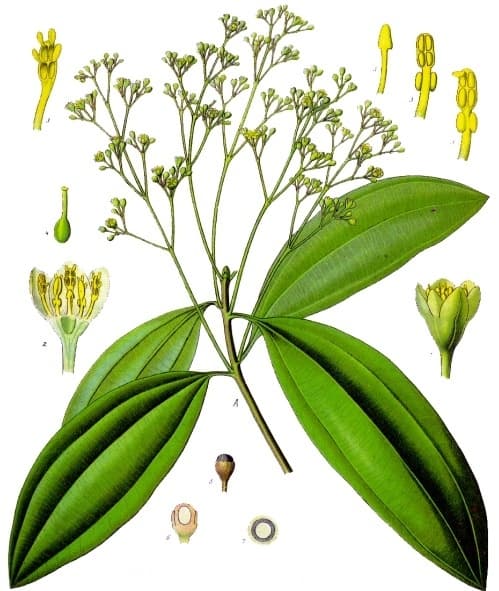
Cinnamomum cassia, called Chinese cassia, cassia cinnamon, or Chinese cinnamon, is an evergreen tree originating in southern China and widely cultivated there and elsewhere in South and Southeast Asia. It is one of several species of Cinnamomum used primarily for its aromatic bark, which is used as a spice. The buds are also used as a spice, especially in India, and were used by the ancient Romans.
Highlighted compounds are flavor-active · click to view molecular profile
Turmeric
20 shared
Based on shared molecular compounds · click to explore
What science says
compound effect
“Moreover, the fluidity, potential, and intracellular pH of the cytoplasmic membrane were perturbed in the presence of the essential oil or trans-cinnamaldehyde”
Cinnamomum cassia essential oil→perturbs→proton motive force
“In the presence of C. cassia essential oil or trans-cinnamaldehyde at their minimal bactericidal concentration (2700 μg·mL(-1)), L. innocua cells fluoresced green after staining with Syto9® and propidium iodide, as observed by epifluorescence microscopy, suggesting that the perturbation of membrane did not cause large pore formation and cell lysis but may have introduced the presence of viable but nonculturable bacteria”
“Moreover, the fluidity, potential, and intracellular pH of the cytoplasmic membrane were perturbed in the presence of the essential oil or trans-cinnamaldehyde”
“Cinnamomum cassia, Cinnamosma fragrans, Eucalyptus citriodora, Eucalyptus dives, Eugenia caryophyllata, Melaleuca quinquinervia, Nepeta cataria, Pelargonium roseum, Salvia officinalis et Satureja montana — ont inhibé le développement de P. aeruginosa avec un diamètre d’inhibition supérieur à 13 mm.”
“The results showed it was stronger effect against Staphylococcus aureus with both the largest ZOI of 27.4 mm and the lowest minimum inhibitory concentration (MIC) of 2.5 mg/mL and minimum bactericidal concentration (MBC) of 5.0 mg/mL respectively.”
essential oil from Cinnamomum cassia bark→has antibacterial effect→stronger against Staphylococcus aureus