PubChem CID · CC0
1-methyl-4-propan-2-yl-7-oxabicyclo[2.2.1]heptane
Foods containing this compound
The roselle (Hibiscus sabdariffa) is a species of Hibiscus native to the west Africa, used for the production of bast fibre and as an infusion. It is an annual or perennial herb or woody-based subshrub, growing to 2?2.5 m (7?8 ft) tall. The leaves are deeply three- to five-lobed, 8?15 cm (3?6 in) long, arranged alternately on the stems.

The Key lime (Citrus × aurantiifolia) is a citrus species with a globose fruit, 2.5-5 cm in diameter (1-2 in), that is yellow when ripe but usually picked green commercially. It is smaller and seedier, with a higher acidity, a stronger aroma, and a thinner rind, than that of the Persian lime (Citrus × latifolia). It is valued for its unique flavor compared to other limes, with the Key lime usually having a more tart and bitter flavor. The name comes from its association with the Florida Keys, where it is best known as the flavoring ingredient in Key lime pie. It is also known as West Indian lime, bartender's lime, Omani lime, or Mexican lime, the latter classified as a distinct race with a thicker skin and darker green color. Philippine varieties have various names, including dayap and bilolo.
Cardamom (or cardamon) refers to several plants of the similar genera Elettaria and Amomum in the ginger family Zingiberaceae. Both genera are native to India, Nepal and Bhutan; they are recognised by their small seed pods, triangular in cross-section and spindle-shaped, with a thin, papery, outer shell and small black seeds. Today, Guatemala is the biggest producer and exporter of cardamom in the world, followed by India. Some other countries such as Sri Lanka have also begun to cultivate it. Elettaria pods are light green while Amomum pods are larger and dark brown. It is the world's third most expensive spice by weight, outstripped in market value only by saffron and vanilla.

Illicium verum, commonly called Star anise, star aniseed, or Chinese star anise is a spice that closely resembles anise in flavor, obtained from the star-shaped pericarp of Illicium verum, a medium-sized native evergreen tree of northeast Vietnam and southwest China. The star shaped fruits are harvested just before ripening.

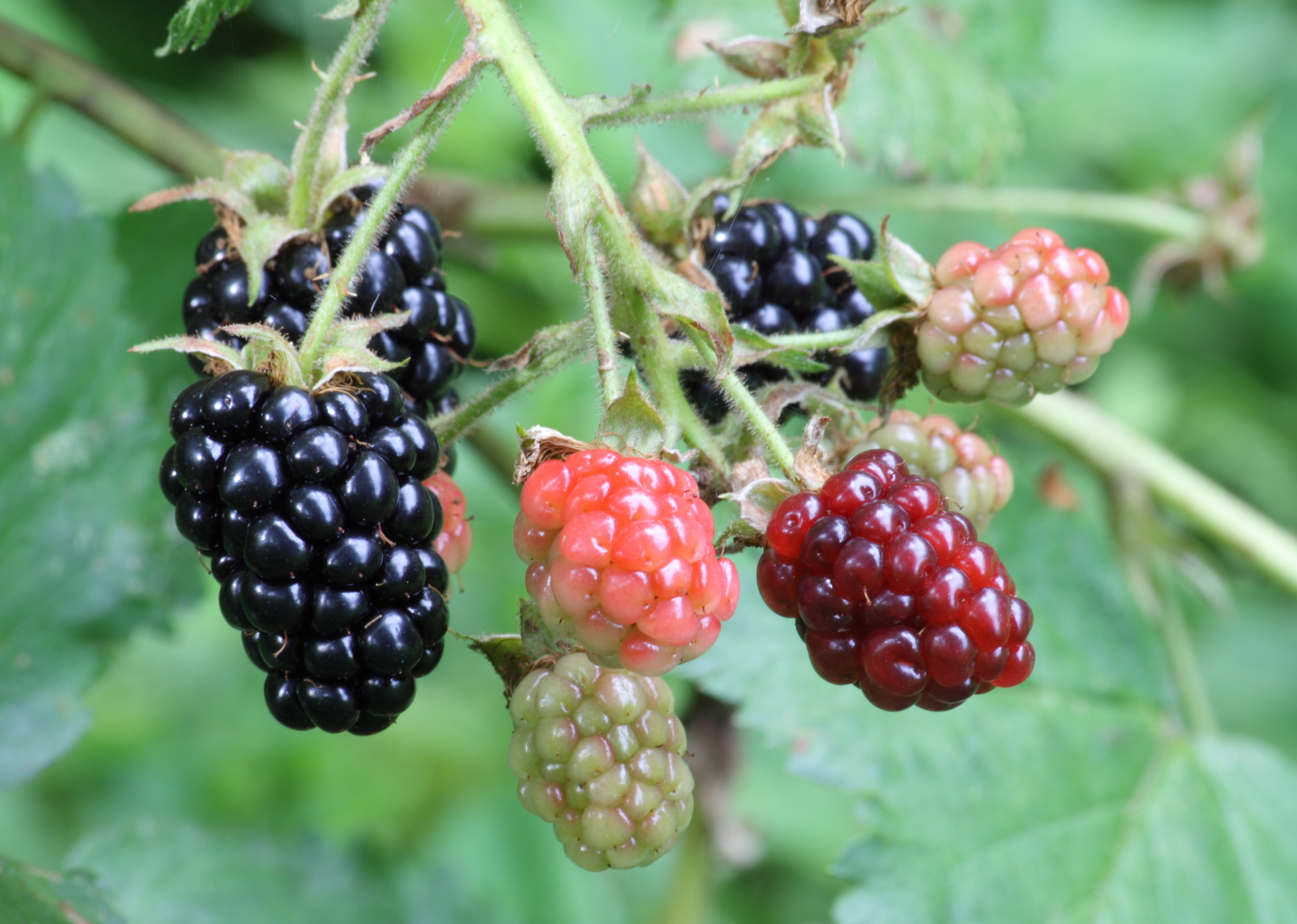
Rubus laciniatus, commonly called evergreen blackberry or cutleaf blackberry, is a species of blackberry that is native to Eurasia. It has been introduced to Australia and North America, and become a weed and highly invasive species in forested habitats in the United States and Canada, it is very difficult to control. Evergreen blackberry is a deciduous shrub that grows up to 3 meters tall with prickly shoots. The flowers are in clusters, the petals are pink or white. The fruits are shiny and black, similar to the common blackberry, with a unique and fruitier taste. The fruits are not true berries in the botanical sense. [Wikipedia]

The blackberry is an edible fruit produced by many species in the genus Rubus in the family Rosaceae. Blackberry is a perennial plant that grows to 3-6 meter tall. The pale pink flowers are produced in late spring and early summer. The fruits are rich in vitamin C, anthocyanins, flavonols and ellagitannins (PMID: 22082199), they have shown the beneficial effects to human health (PMID: 22082199)
Source
Compound data linked to PubChem CID 10106, public domain via NCBI. Culinary context + ingredient mappings are maintained by Foodgeist's enrichment fleet and continuously re-matched by the pairings engine. PubChem CID 10106