Foodgeist is a participant in the Amazon Services LLC Associates Program, an affiliate advertising program designed to provide a means for sites to earn advertising fees by advertising and linking to Amazon.com. As an Amazon Associate we earn from qualifying purchases.
Sesame (Spices) — Ingredient · Foodgeist
Ingredient
Sesame
Plant cultivated for its edible seeds
Spices
About
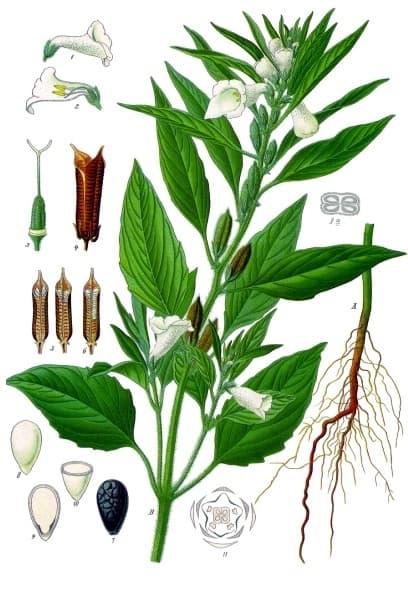
Sesame is a plant in the genus Sesamum, also called benne. Numerous wild relatives occur in Africa and a smaller number in India. It is widely naturalized in tropical regions around the world and is cultivated for its edible seeds, which grow in pods. World production in 2024 was 6.7 million tonnes, with India, Myanmar, and Sudan as the largest producers.
Aroma profile
Derived from this ingredient’s flavor compounds
fresh×6
aromatic×6
mint×4
camphoraceous×4
grassy×4
green×4
pungent×4
cooling×3
Taste profile
Derived from this ingredient's compounds · measured taste classes
Ranked across every axis at once: shared flavor chemistry, real-recipe co-use, novel-discovery, and nutrient synergy. Pairs agreeing on two or more axes lead.
Molecular affinity
Pairs well with — ingredients that share aroma compounds
sesame seed-based foods→ were reported →consumed by 82% of cases
“Fifty-four (82%) reported consumption of sesame seed-based foods.”
sesame-based products→ were positive for Salmonella spp. →in other jurisdictions
number_of_products: three products in Canada and one in the United Kingdom
“On the basis of our investigations sesame-based products were sampled in other jurisdictions and three products in Canada and one in the United Kingdom were positive for Salmonella spp.”
Salmonella spp.→ detected in →plant origin food (salad dressing, fruit juice, sesame)
“Salmonella spp. has been detected in a range of foods, and outbreaks have predominantly been associated with animal products such as eggs, poultry and dairy products, but also with plant origin food such as salad dressing, fruit juice and sesame”
What science says
ingredient property
“On the basis of mass spectrometry (MS) analysis of tryptic fragments, the 52, 38, and 16 kDa subunits presented sequence homology with sesame vicilin, whereas the 66 kDa subunit showed sequence similarity with a putative vicilin.”
52, 38, and 16 kDa subunits→presented→sequence homology with sesame vicilin