Skip to content Foodgeist is a participant in the Amazon Services LLC Associates Program, an affiliate advertising program designed to provide a means for sites to earn advertising fees by advertising and linking to Amazon.com. As an Amazon Associate we earn from qualifying purchases.
Mytilus edulis (food) — Ingredient · Foodgeist
Home / Ingredients / Mytilus edulis Ingredient
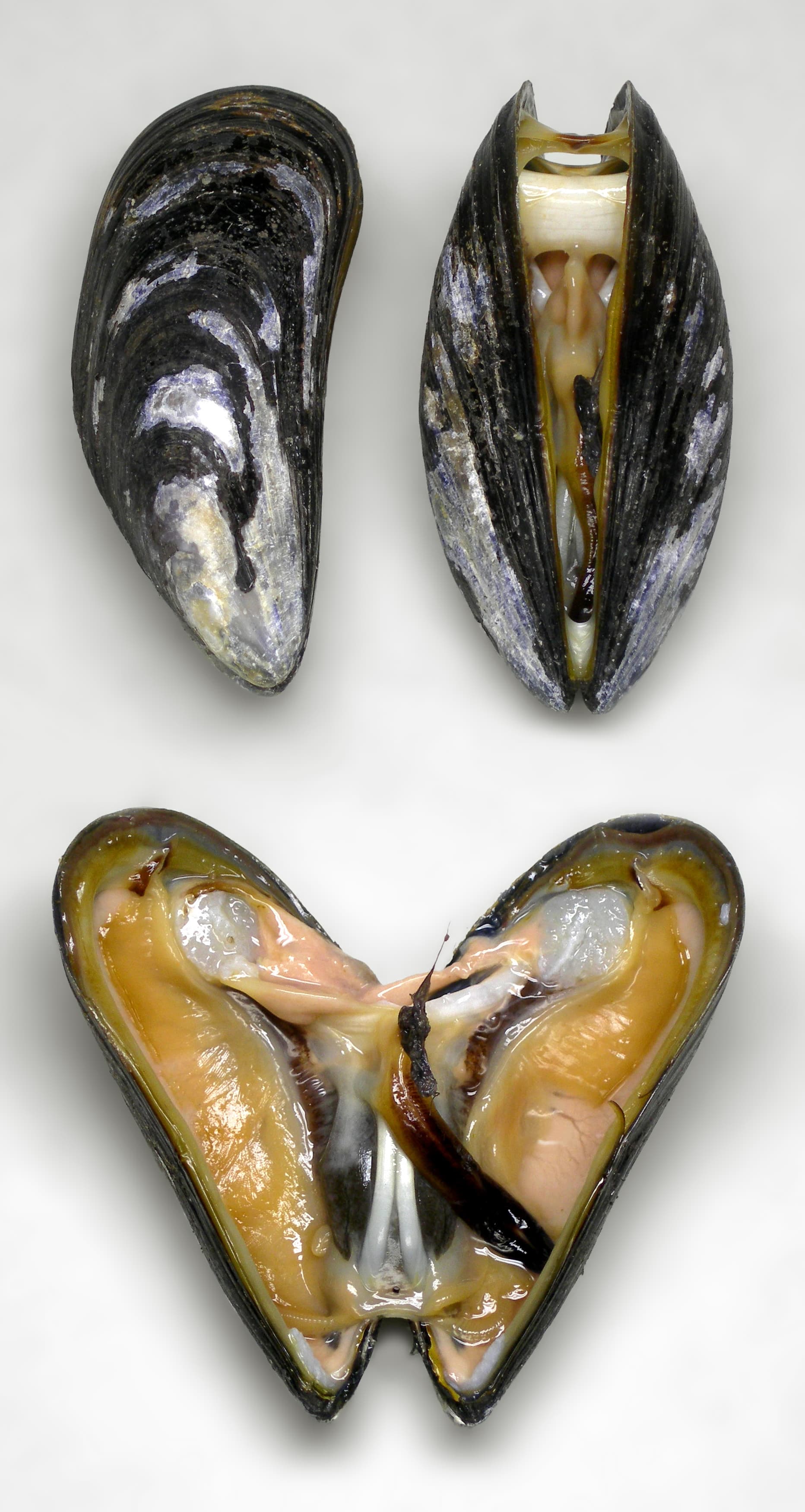
Mytilus edulis species of mollusc
Cook with Mytilus edulis As an Amazon Associate, Foodgeist earns from qualifying purchases.
About The blue mussel, also known as the common mussel, is a medium-sized edible marine bivalve mollusc in the family Mytilidae, the only extant family in the order Mytilida, known as "true mussels". Blue mussels are subject to commercial use and intensive aquaculture. A species with a large range, the blue mussel leaves empty shells that are commonly found on beaches around the world.
Aroma profile Derived from flavor compounds · verified measured labels + GNN ensemble predictions
0 ×15
1 ×4
2 ×4
minty
sweet
fruity
Flavor compounds 29 compounds identified — FoodAtlas / FooDB verified
saxitoxin saxitoxin(2+) azaspiracid azaspiracid-1 tioguanine defensin ibuprofen ibuprofen(1-) dexibuprofen domoic acid diiodine methylmercury(.) protein polypeptide chain protein pyrimethamine polybutadiene macromolecule lead(0) Molecular pairings Pairs well with — computed from shared flavor compounds
Source & License Imported 6/2/2026, 8:32:22 AM
Verification Multi-layer verified
Share Pinterest converts best for culinary content lead(2+)
okadaic acid
hypotaurine zwitterion
hypotaurine
omega-3 fatty acid
all-cis-5,8,11,14,17-icosapentaenoic acid
docosahexaenoic acid
dehydroepiandrosterone
vitamin b12
cobalamin
Highlighted compounds are flavor-active · click to view molecular profile
Based on shared molecular compounds · click to explore
Vibrio parahaemolyticus → isolated from → Norwegian Blue Mussels (Mytilus edulis)
percentage: 10.3%
“Vibrio parahaemolyticus, V. cholerae, and V. vulnificus were isolated from 10.3%, 1.0%, and 0.1% of 885 blue mussel samples, respectively.”
trh(+) V. parahaemolyticus → isolated from → Norwegian Blue Mussels (Mytilus edulis)
number_of_samples: 4
“Four of the samples contained trh(+) V. parahaemolyticus, while no tdh-positive isolates were detected.”
Vibrio vulnificus → isolated from → Norwegian Blue Mussels (Mytilus edulis)
percentage: 0.1%
“Vibrio parahaemolyticus, V. cholerae, and V. vulnificus were isolated from 10.3%, 1.0%, and 0.1% of 885 blue mussel samples, respectively.”
Vibrio cholerae → isolated from → Norwegian Blue Mussels (Mytilus edulis)
percentage: 1.0%
“Vibrio parahaemolyticus, V. cholerae, and V. vulnificus were isolated from 10.3%, 1.0%, and 0.1% of 885 blue mussel samples, respectively.”
What science says safety threshold “Vibrio parahaemolyticus, V. cholerae, and V. vulnificus were isolated from 10.3%, 1.0%, and 0.1% of 885 blue mussel samples, respectively.”
Vibrio parahaemolyticus → isolated from → Norwegian Blue Mussels (Mytilus edulis)
safety threshold “Four of the samples contained trh(+) V. parahaemolyticus, while no tdh-positive isolates were detected.”
trh(+) V. parahaemolyticus → isolated from → Norwegian Blue Mussels (Mytilus edulis)
safety threshold “Vibrio parahaemolyticus, V. cholerae, and V. vulnificus were isolated from 10.3%, 1.0%, and 0.1% of 885 blue mussel samples, respectively.”
Vibrio vulnificus → isolated from → Norwegian Blue Mussels (Mytilus edulis)
safety threshold “Vibrio parahaemolyticus, V. cholerae, and V. vulnificus were isolated from 10.3%, 1.0%, and 0.1% of 885 blue mussel samples, respectively.”
Vibrio cholerae → isolated from → Norwegian Blue Mussels (Mytilus edulis)