Japanese pumpkin + Romaine lettuce
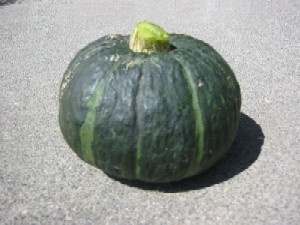
Kabocha, Danhobak, or Fak Thong is an Asian variety of winter squash of the species <i>Cucurbita maxima</i>. The word kabocha has come to mean a general type of winter squash to many English-speaking growers and buyers. In some cultures it is revered as an aphrodisiac. Kabocha is commonly called Japanese pumpkin, especially in Australia and New Zealand. It is also called kabocha squash in North America. In Japan, the word kabocha may refer to either this squash or to the Western-style pumpkin. Varieties include: Ajihei, Ajihei No. 107, Ajihei No. 331, Ajihei No. 335, Cutie, Ebisu, Emiguri, and Miyako. Today, many of the kabocha in the market are of the type called Kuri kabocha, which was created based on Seiyo kabocha (buttercup squash). It is popular for its strong yet sweet flavor and moist, fluffy texture, which is like chestnuts. It is found in the market under such brand names as Miyako, Ebisu, Kurokawa, and Akazukin. (Wikipedia)

Romaine or cos lettuce is a variety of lettuce (<i>Lactuca sativa</i> L. var. <i>longifolia</i>) that grows in a tall head of sturdy leaves with firm ribs down their centers. Unlike most lettuces, it is tolerant of heat. As with other dark leafy greens, the antioxidants contained within romaine lettuce are believed to help prevent cancer. (Wikipedia)
Shared flavor compounds
These compounds appear in both Japanese pumpkin and Romaine lettuce, giving them a molecular basis for flavor affinity, the pairing principle articulated by Francois Benzi and implemented in flavor-pairing research.
Why it works
The flavor-pairing hypothesis proposes that ingredients sharing significant aromatic compounds harmonize on the palate. Japanese pumpkin and Romaine lettuce overlap on 20 key compound(s), which is why classic culinary traditions, and our deterministic matching algorithm, place them together.
- Pairing computed by: pairing-compute
- Methodology: deterministic compound-overlap matching (no LLM)
- Compound data: Wikidata + Wikidata
- Part of: Living Gastronomic Intelligence graph