About
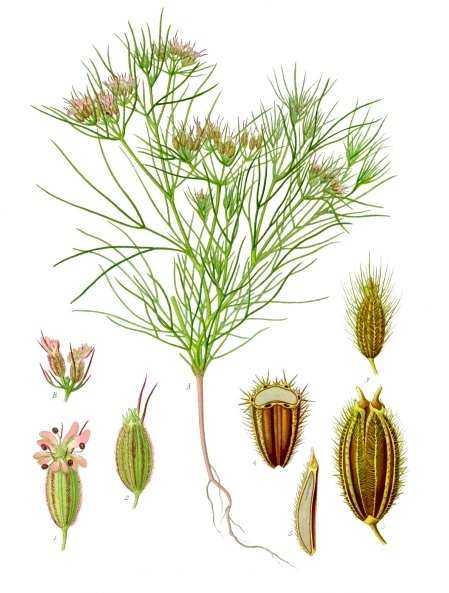
Cumin (Cuminum cyminum) is a flowering plant in the family Apiaceae as caraway, parsley, and dill., native from the east Mediterranean to India. Its seeds (each one contained within a fruit, which is dried) are used in the cuisines of many different cultures, in both whole and ground form. It also has many uses as a traditional medicinal plant. In the ancient Egyptian civilization, cumin was used as spice and as preservative in mummification. Cumin seed is used as a spice for its distinctive flavour and aroma. Cumin can be found in some cheeses, such as Leyden cheese, and in some traditional breads from France. Cumin can be an ingredient in chili powder (often Tex-Mex or Mexican-style), and is found in achiote blends, adobos, sofrito, garam masala, curry powder, and bahaarat. In South Asian cooking, it is often combined with coriander seeds in a powdered mixture called dhana jeera. Cumin's distinctive flavour is strong. It has a warm aroma due to its essential oil content. Its main constituent aroma compounds are cuminaldehyde (a promising agent against alpha-synuclein aggregation) and cuminic alcohol. Other important aroma compounds of toasted cumin are the substituted pyrazines, 2-ethoxy-3-isopropylpyrazine, 2-methoxy-3-sec-butylpyrazine, and 2-methoxy-3-methylpyrazine. Other components include γ-terpinene, safranal, p-cymene and β-pinene [Wikipedia]
Aroma profile
Derived from this ingredient’s flavor compounds
Taste profile
Derived from this ingredient's compounds · measured taste classes
Composition
60 compounds identified — cross-referenced scientific databases
Best pairings
Ranked across every axis at once: shared flavor chemistry, real-recipe co-use, novel-discovery, and nutrient synergy. Pairs agreeing on two or more axes lead.
Molecular affinity
Pairs well with — ingredients that share aroma compounds
Research Evidence
The Geist can be wrong. Some flavor, taste, and pairing values are model-predicted, not lab-measured.