Foodgeist is a participant in the Amazon Services LLC Associates Program, an affiliate advertising program designed to provide a means for sites to earn advertising fees by advertising and linking to Amazon.com. As an Amazon Associate we earn from qualifying purchases.
Coriander — Ingredient · Foodgeist
Ingredient
Coriander
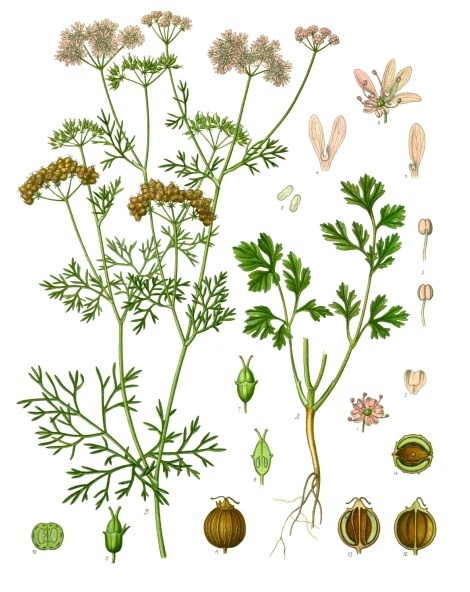
Coriander (Coriandrum sativum), also known as cilantro, Chinese parsley or dhania, is an annual herb in the family Apiaceae. Coriander is native to regions spanning from southern Europe and North Africa to southwestern Asia. It is a soft, hairless plant growing to 50 cm tall. The
About
Coriander (Coriandrum sativum), also known as cilantro, Chinese parsley or dhania, is an annual herb in the family Apiaceae. Coriander is native to regions spanning from southern Europe and North Africa to southwestern Asia. It is a soft, hairless plant growing to 50 cm tall. The leaves are variable in shape, broadly lobed at the base of the plant, and slender and feathery higher on the flowering stems. The flowers are borne in small umbels, white or very pale pink, asymmetrical, with the petals pointing away from the centre of the umbel longer (5–6 mm) than those pointing towards it (only 1–3 mm long). The fruit is a globular, dry schizocarp 3–5 mm ( ) in diameter.
Aroma profile
Derived from this ingredient’s flavor compounds
aromatic×8
fresh×7
grassy×6
mint×5
camphoraceous×5
floral×5
herbal×5
herbaceous×5
Taste profile
Derived from this ingredient's compounds · measured taste classes
Ranked across every axis at once: shared flavor chemistry, real-recipe co-use, novel-discovery, and nutrient synergy. Pairs agreeing on two or more axes lead.
Molecular affinity
Pairs well with — ingredients that share aroma compounds
“Linalool (40.9-79.9%), neryl acetate (2.3-14.2%), gamma-terpinene (0.1-13.6%) and alpha-pinene (1.2-7.1%) were identified as main components in the oil of the coriander accessions.”
“Linalool (40.9-79.9%), neryl acetate (2.3-14.2%), gamma-terpinene (0.1-13.6%) and alpha-pinene (1.2-7.1%) were identified as main components in the oil of the coriander accessions.”
“The different parts of this plant contain monoterpenes, limpnene, α‐pinene, γ‐terpinene, p‐cymene, citronellol, borneol, camphor, coriandrin, geraniol, dihydrocoriandrin, coriandronsA‐E, flavonoids and essential oils.”
“In evaluating the antimicrobial potency of coriander oil against C. jejuni on beef and chicken meat at 4 degrees C and 32 degrees C, it was found that the oil reduced the bacterial cell load in a dose-dependent manner.”