Foodgeist is a participant in the Amazon Services LLC Associates Program, an affiliate advertising program designed to provide a means for sites to earn advertising fees by advertising and linking to Amazon.com. As an Amazon Associate we earn from qualifying purchases.
Lagenaria siceraria (synonym Lagenaria vulgaris Ser. ), bottle gourd, opo squash or long melon is a vine grown for its fruit, which can either be harvested young and used as a vegetable, or harvested mature, dried, and used as a bottle, utensil, or pipe. For this reason, the cala
Cook with Calabash
As an Amazon Associate, Foodgeist earns from qualifying purchases.
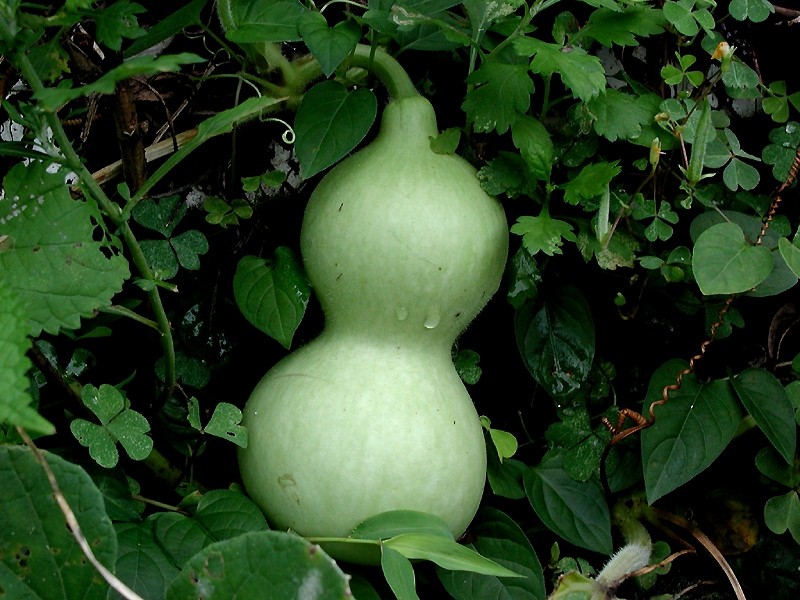
Lagenaria siceraria (synonym Lagenaria vulgaris Ser. ), bottle gourd, opo squash or long melon is a vine grown for its fruit, which can either be harvested young and used as a vegetable, or harvested mature, dried, and used as a bottle, utensil, or pipe. For this reason, the calabash is widely known as the bottle gourd. The fresh fruit has a light green smooth skin and a white flesh. Rounder varieties are called calabash gourds. They come in a variety of shapes, they can be huge and rounded, or small and bottle shaped, or slim and more than a meter long. The calabash was one of the first cultivated plants in the world, grown not primarily for food, but for use as a water container. The bottle gourd may have been carried from Africa to Asia, Europe and the Americas in the course of human migration. It shares its common name with that of the calabash tree.
“The value of the fat, protein, nitrogen, crude fibre, moisture content, sucrose, fructose, galactose and energy content are quite high viz; 1.13, 8.35, 1.34, 4.28, 84.92, 59.86, 25.09, 18.24 and 88.69%, respectively.”
“The value of the fat, protein, nitrogen, crude fibre, moisture content, sucrose, fructose, galactose and energy content are quite high viz; 1.13, 8.35, 1.34, 4.28, 84.92, 59.86, 25.09, 18.24 and 88.69%, respectively.”
“The presence of phytochemicals like saponins, flavonoid, cardenolides, tannins and phenol as well as the presence of hydrogen cyanide were observed in the fruit sample.”
“The value of the fat, protein, nitrogen, crude fibre, moisture content, sucrose, fructose, galactose and energy content are quite high viz; 1.13, 8.35, 1.34, 4.28, 84.92, 59.86, 25.09, 18.24 and 88.69%, respectively.”