Carob + Oregon yampah
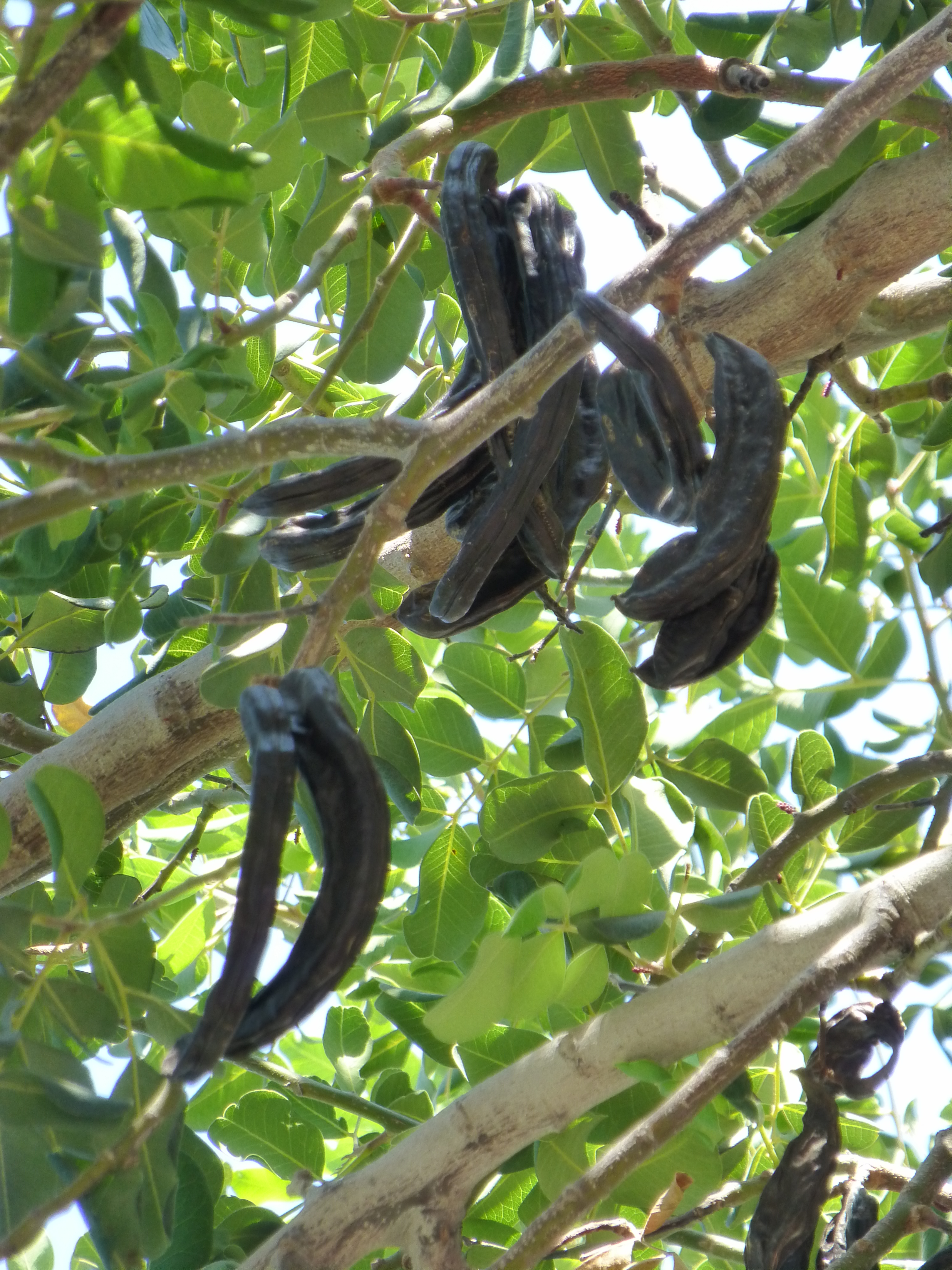
Ceratonia siliqua, commonly known as the carob tree and St John's-bread, is a species of flowering evergreen shrub or tree in the pea family, Fabaceae. It is widely cultivated for its edible pods, and as an ornamental tree in gardens. The ripe, dried pod is often ground to carob powder which is used as a substitute for cocoa powder.
Perideridia oregana is a species of flowering plant in the carrot family known by the common name Oregon yampah or Eppaw. It is native to Oregon and California in the western United States, where it grows in woodland and other habitat. This plant is quite variable in appearance. In general, it is a perennial herb 10 to 90 centimeters tall, its green to waxy-grayish erect stem growing from a cluster of small tubers. Leaves near the base of the plant have blades 3 to 30 centimeters long divided into a variable number of leaflets, which may be subdivided into smaller segments. The inflorescence is a compound umbel of many spherical clusters of small white flowers. These yield ribbed, oblong-shaped fruits 3 to 6 millimeters long.
Shared flavor compounds
These compounds appear in both Carob and Oregon yampah, giving them a molecular basis for flavor affinity, the pairing principle articulated by Francois Benzi and implemented in flavor-pairing research.
Why it works
The flavor-pairing hypothesis proposes that ingredients sharing significant aromatic compounds harmonize on the palate. Carob and Oregon yampah overlap on 20 key compound(s), which is why classic culinary traditions, and our deterministic matching algorithm, place them together.
- Pairing computed by: pairing-compute
- Methodology: deterministic compound-overlap matching (no LLM)
- Compound data: Wikidata + Wikidata
- Part of: Living Gastronomic Intelligence graph