Calabash + Chinese broccoli
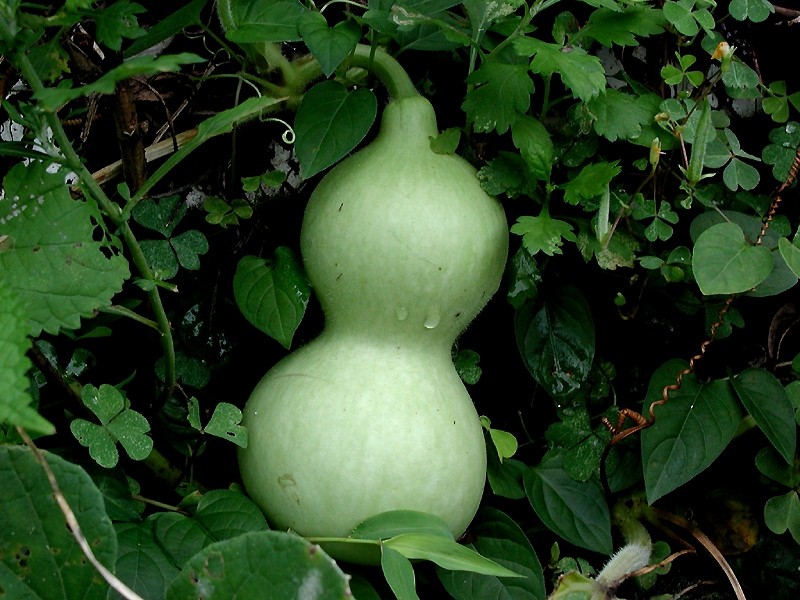
Lagenaria siceraria (synonym Lagenaria vulgaris Ser. ), bottle gourd, opo squash or long melon is a vine grown for its fruit, which can either be harvested young and used as a vegetable, or harvested mature, dried, and used as a bottle, utensil, or pipe. For this reason, the calabash is widely known as the bottle gourd. The fresh fruit has a light green smooth skin and a white flesh. Rounder varieties are called calabash gourds. They come in a variety of shapes, they can be huge and rounded, or small and bottle shaped, or slim and more than a meter long. The calabash was one of the first cultivated plants in the world, grown not primarily for food, but for use as a water container. The bottle gourd may have been carried from Africa to Asia, Europe and the Americas in the course of human migration. It shares its common name with that of the calabash tree.

Kai-lan (also written as gai-lan) is the Cantonese name for a vegetable that is also known as Chinese broccoli or Chinese kale. It is a leaf vegetable featuring thick, flat, glossy blue-green leaves with thick stems and a small number of tiny flower heads similar to those of broccoli. Broccoli and kai-lan belong to the same species Brassica oleracea, but kai-lan is in the group alboglabra [Latin albus+glabrus white and hairless]. Its flavor is very similar to that of broccoli, but slightly more bitter. It is also noticeably stronger. Broccolini is a hybrid between broccoli and kai-lan, produced by Mann Packing Company, Inc.
Shared flavor compounds
These compounds appear in both Calabash and Chinese broccoli, giving them a molecular basis for flavor affinity, the pairing principle articulated by Francois Benzi and implemented in flavor-pairing research.
Why it works
The flavor-pairing hypothesis proposes that ingredients sharing significant aromatic compounds harmonize on the palate. Calabash and Chinese broccoli overlap on 20 key compound(s), which is why classic culinary traditions, and our deterministic matching algorithm, place them together.
- Pairing computed by: pairing-compute
- Methodology: deterministic compound-overlap matching (no LLM)
- Compound data: Wikidata + Wikidata
- Part of: Living Gastronomic Intelligence graph