squamocin
Molecular structure
Foods containing this compound
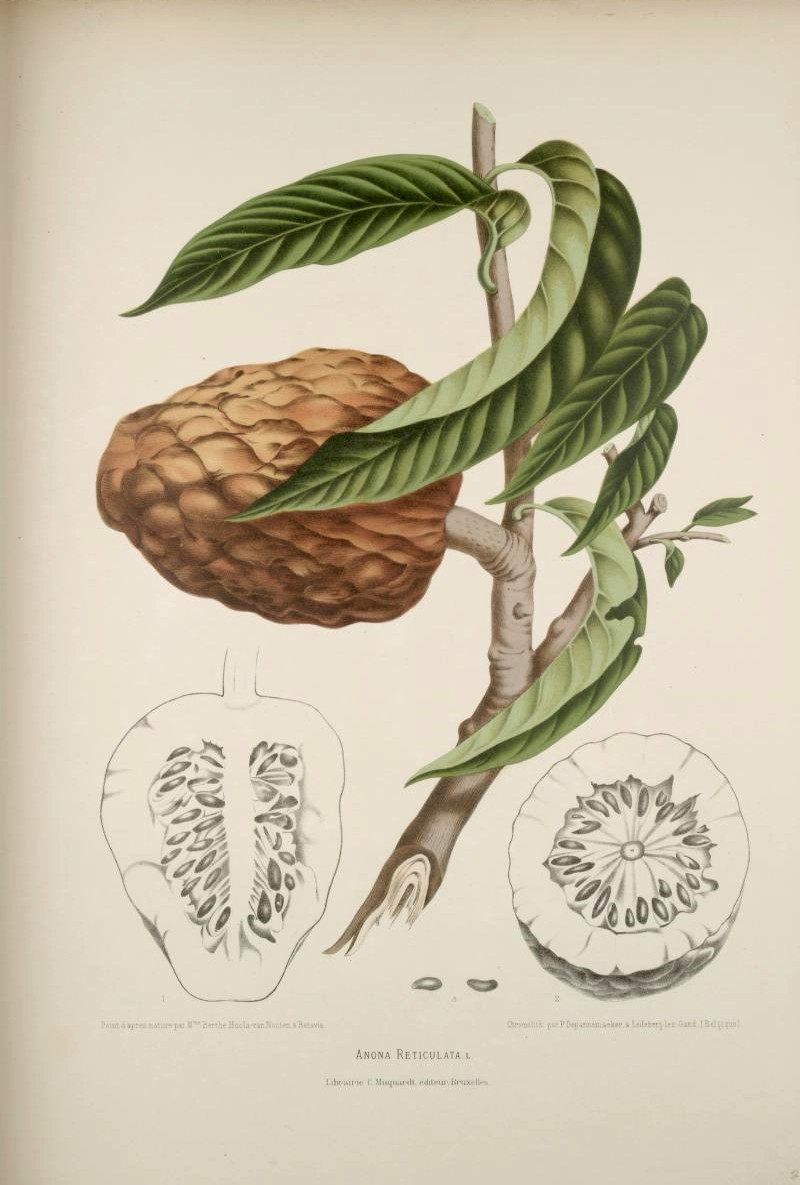


Custard apple, is a common name for a fruit, and the tree which bears it, Annona reticulata Custard apple may also refer to similar fruits produced by related trees: Annonaceae, the custard apple or soursop family. Annona cherimola, a tree and fruit also called cherimoya. Annona squamosa, a tree and fruit also called sugar apple or sweetsop Annona senegalensis, a tree and fruit called wild custard-apple Casimiroa edulis, also called white sapote, a fruit related to the citrus.

The papaya, papaw, or pawpaw is the fruit of the plant Carica papaya, the sole species in the genus Carica of the plant family Caricaceae. It is native to the tropics of the Americas, perhaps from southern Mexico and neighbouring Central America. It was first cultivated in Mexicoseveral centuries before the emergence of the Mesoamerican classical civilizations. The papaya is a large, tree-like plant, with a single stem growing from 5 to 10 m (to ft) tall, with spirally arranged leaves confined to the top of the trunk. The lower trunk is conspicuously scarred where leaves and fruit were borne. The leaves are large, 50–70 cm in diameter, deeply palmately lobed, with seven lobes. Unusually for such large plants, the trees are dioecious. The tree is usually unbranched, unless lopped. The flowers are similar in shape to the flowers of the Plumeria, but are much smaller and wax-like. They appear on the axils of the leaves, maturing into large fruit - 15–45 cm long and 10–30 cm in diameter. The fruit is ripe when it feels soft (as soft as a ripe avocado or a bit softer) and its skin has attained an amber to orange hue. Carica papaya was the first transgenic fruit tree to have its genome deciphered.

Soursop is the fruit of Annona muricata, a broadleaf, flowering, evergreen tree native to Mexico, Cuba, Central America, the Caribbean and northern South America: Colombia, Brazil, Peru, Ecuador and Venezuela. Soursop is also produced in Somalia. Today, it is also grown in some areas of Southeast Asia, as well as in some Pacific islands. It was most likely brought from Mexico to the Philippines by way of the Manila-Acapulco Galleon trade. It is in the same genus as the chirimoya and the same family as the pawpaw. Soursop, raw, edible parts Nutritional value per 100 g Energy 276 kJ Carbohydrates 16.84 g - Sugars 13.54 g - Dietary fiber 3.3 g Fat 0.30 g Protein 1.00 g Vitamin A equiv. 0 μg (0%) Thiamine (vit. B1) 0.070 mg (6%) Riboflavin (vit. B2) 0.050 mg (4%) Niacin (vit. B3) 0.900 mg (6%) Vitamin B6 0.059 mg (5%) Folate (vit. B9) 14 μg (4%) Vitamin C 20.6 mg (25%) Calcium 14 mg (1%) Iron 0.6 mg (5%) Magnesium 21 mg (6%) Phosphorus 27 mg (4%) Potassium 278 mg (6%) Zinc 0.1 mg (1%) Percentages are relative toUS recommendations for adults. The soursop is adapted to areas of high humidity and relatively warm winters; temperatures below 5 °C will cause damage to leaves and small branches, and temperatures below 3 °C can be fatal. The fruit becomes dry and is no longer good for concentrate. Other common names include: Evo, Aluguntugui guanábana, graviola, anona, corossol, sorsaka, adunu, Brazilian pawpaw, guyabano, guanavana, toge-banreisi, durian benggala, nangka blanda, sirsak, zuurzak and nangka londa. In Malayalam, it is called mullaatha, literally thorny custard apple. The other lesser-known Indian names are shul-ram-fal and Lakshmana Phala. and in Harar (Ethiopia) in Harari language known for centuries as Amba Shoukh (Thorny Mango or Thorny Fruit). The flavour has been described as a combination of strawberry and pineapple, with sour citrus flavour notes contrasting with an underlying creamy flavour reminiscent of coconut or banana.

fruit from Asimina triloba
Verified Data
Compound identity and culinary context are continuously cross-referenced across open scientific databases and maintained by Foodgeist's enrichment pipeline.
The Geist can be wrong. Some flavor, taste, and pairing values are model-predicted, not lab-measured.