1-pentadecene
Molecular structure
Mass spectrum
A real measured fragmentation pattern · 1 of 3 experimental spectra
Foods containing this compound

Arctium lappa, commonly called greater burdock, gob?,edible burdock, lappa, or beggar's buttons, is a biennial plant of the Arctium (burdock) genus in the Asteraceae family, cultivated in gardens for its root used as a vegetable. It is an invasive weed of high-nitrogen soils.
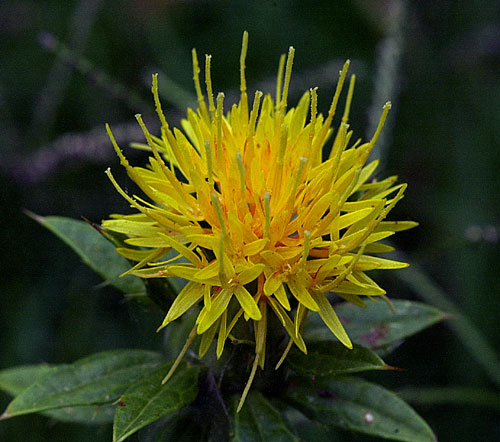
Safflower is a highly branched, herbaceous, thistle-like annual. It is commercially cultivated for vegetable oil extracted from the seeds. Plants are 30 to 150 cm (to in) tall with globular flower heads having yellow, orange, or red flowers. Each branch will usually have from one to five flower heads containing 15 to 20 seeds per head. Safflower is native to arid environments having seasonal rain. It grows a deep taproot which enables it to thrive in such environments.
Watermelon (Citrullus lanatus, family Cucurbitaceae) is a vine-like (scrambler and trailer) flowering plant originally from southern Africa. Its fruit, which is also called watermelon, is a special kind referred to by botanists as a pepo, a berry which has a thick rind and fleshy center (mesocarp and endocarp). Pepos are derived from an inferior ovary, and are characteristic of the Cucurbitaceae. The watermelon fruit, loosely considered a type of melon – although not in the genus Cucumis – has a smooth exterior rind (green, yellow and sometimes white) and a juicy, sweet interior flesh (usually deep red to pink, but sometimes orange, yellow and even green if not ripe).
Verified Data
Compound identity and culinary context are continuously cross-referenced across open scientific databases and maintained by Foodgeist's enrichment pipeline.
The Geist can be wrong. Some flavor, taste, and pairing values are model-predicted, not lab-measured.
