Feijoa + Tree fern
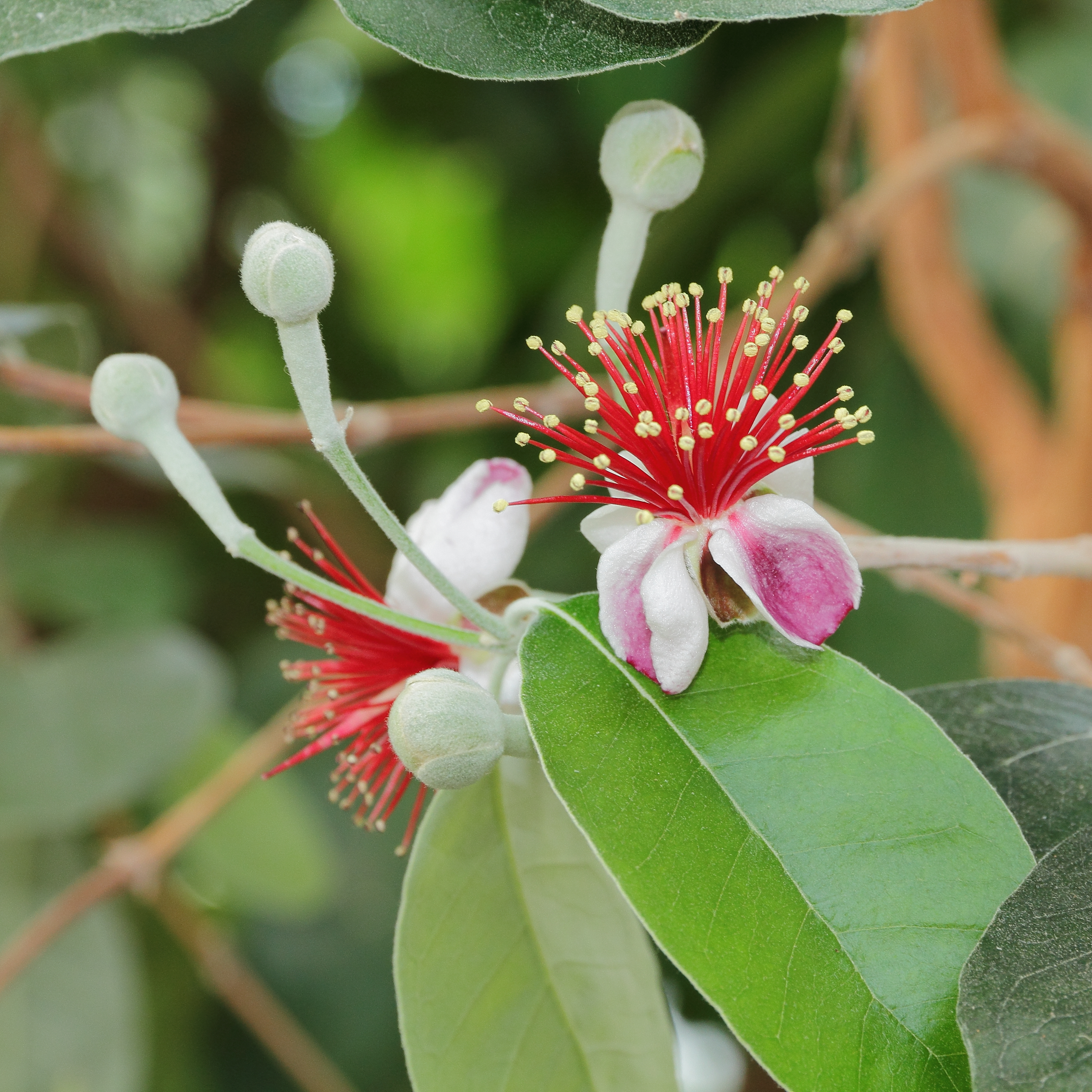
Acca sellowiana, a species of flowering plant in the myrtle family, Myrtaceae, is native to the highlands of southern Brazil, eastern Paraguay, Uruguay, northern Argentina, and Colombia. It is widely cultivated as a garden plant and fruiting tree in New Zealand, and can be found as a garden plant elsewhere such as in Australia, Azerbaijan, western Georgia and southern Russia. Common names include feijoa, pineapple guava and guavasteen. It is an evergreen, perennial shrub or small tree, 1?7 metres (3.3?23.0 ft) in height, widely cultivated as a garden plant and fruiting tree.

The order Cyatheales, which includes the tree ferns, is a taxonomic division of the fern class, Polypodiopsida. No clear morphological features characterize all of the Cyatheales, but DNA sequence data indicate the order is monophyletic. Some species in the Cyatheales have tree-like growth forms, but others have creeping rhizomes (stems). Some species have scales on the stems and leaves, while others have hairs. However, most plants in the Cyatheales are tree ferns and have trunk-like stems up to 20 metres (66 ft) tall. It is unclear how many times the tree form has evolved and been lost in the order.
Shared flavor compounds
These compounds appear in both Feijoa and Tree fern, giving them a molecular basis for flavor affinity, the pairing principle articulated by Francois Benzi and implemented in flavor-pairing research.
Why it works
The flavor-pairing hypothesis proposes that ingredients sharing significant aromatic compounds harmonize on the palate. Feijoa and Tree fern overlap on 20 key compound(s), which is why classic culinary traditions, and our deterministic matching algorithm, place them together.
- Pairing computed by: pairing-compute
- Methodology: deterministic compound-overlap matching (no LLM)
- Compound data: Wikidata + Wikidata
- Part of: Living Gastronomic Intelligence graph