Strawberry guava + Feijoa

Psidium cattleianum, named in honour of notable English horticulturist William Cattley, commonly known as Cattley guava or Peruvian guava, is a small tree (2?6 m tall), bearing small red or yellow fruit, which are somewhat sour but sometimes eaten or made into jam. The red-fruited variety, PSIDIUM LITTORALE Var. Longipes, is known as strawberry guava; the yellow-fruited variety, PSIDIUM LITTORALE Var. Littorale (Lucidum) is variously known as lemon guava, ""Yellow-fruited Cherry Guava"", and in Hawaii as waiaw? and is usually smaller. Native to Brazil and adjacent tropical South America, it is closely related to common guava (P. guajava), and like that species is a widespread, highly invasive species in tropical areas, especially Hawai?i. It tends to form dense, monotypic stands which prevent regrowth of native species, and is very difficult to eradicate; it also provides refuge for fruit flies which cause extensive agricultural damage. As an invasive species, it is sometimes erroneously called Chinese guava. Cherry Guava is sporadically naturalised in coastal areas of Queensland and northern New South Wales. It is also naturalised on Lord Howe Island, Norfolk Island and Christmas Island (Navie 2004; Queensland Herbarium 2008).The yellow variety bears even more heavily than the red and generally has larger fruit.
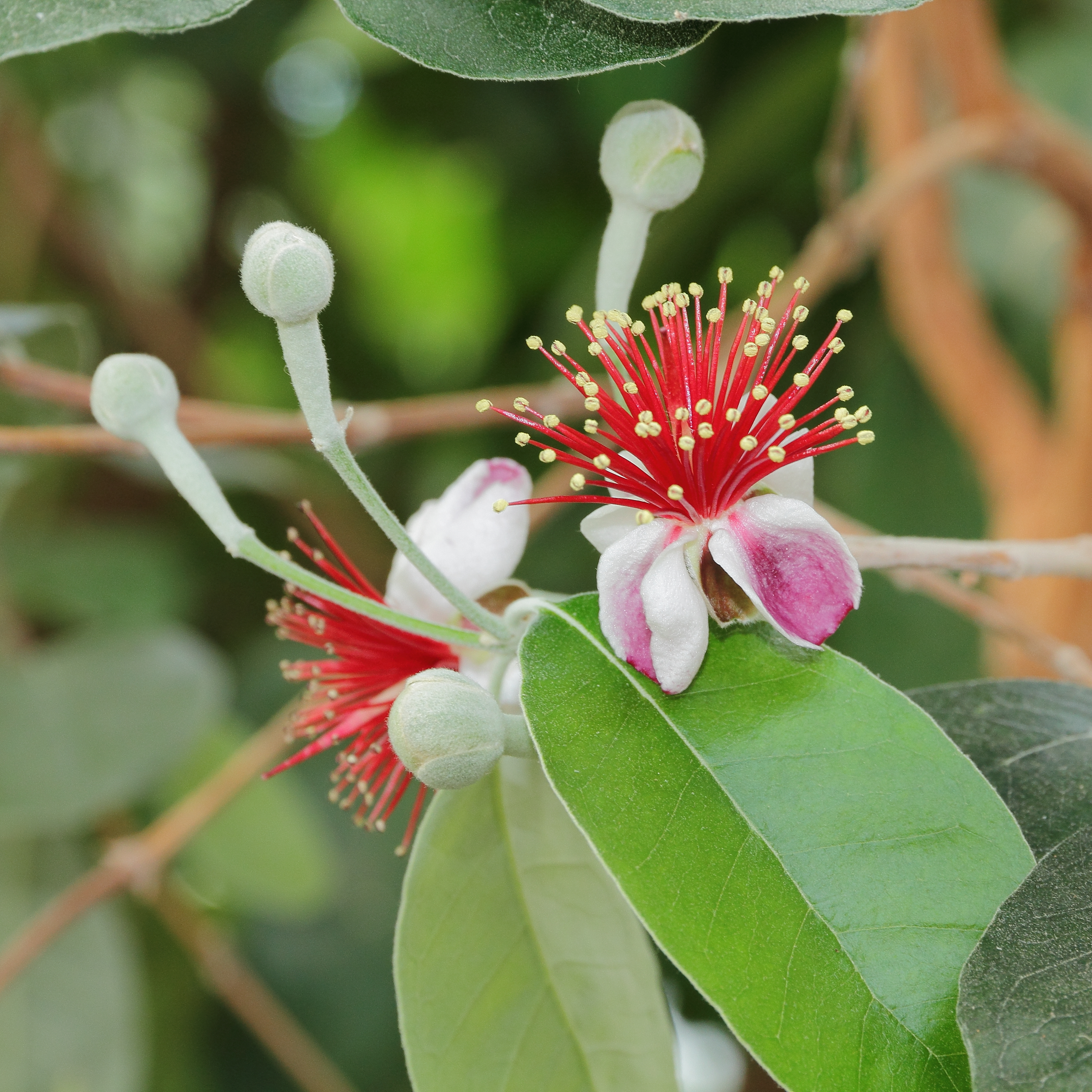
Acca sellowiana, a species of flowering plant in the myrtle family, Myrtaceae, is native to the highlands of southern Brazil, eastern Paraguay, Uruguay, northern Argentina, and Colombia. It is widely cultivated as a garden plant and fruiting tree in New Zealand, and can be found as a garden plant elsewhere such as in Australia, Azerbaijan, western Georgia and southern Russia. Common names include feijoa, pineapple guava and guavasteen. It is an evergreen, perennial shrub or small tree, 1?7 metres (3.3?23.0 ft) in height, widely cultivated as a garden plant and fruiting tree.
Shared flavor compounds
These compounds appear in both Strawberry guava and Feijoa, giving them a molecular basis for flavor affinity, the pairing principle articulated by Francois Benzi and implemented in flavor-pairing research.
Why it works
The flavor-pairing hypothesis proposes that ingredients sharing significant aromatic compounds harmonize on the palate. Strawberry guava and Feijoa overlap on 20 key compound(s), which is why classic culinary traditions, and our deterministic matching algorithm, place them together.
- Pairing computed by: pairing-compute
- Methodology: deterministic compound-overlap matching (no LLM)
- Compound data: Wikidata + Wikidata
- Part of: Living Gastronomic Intelligence graph