Ostrich + Velvet duck
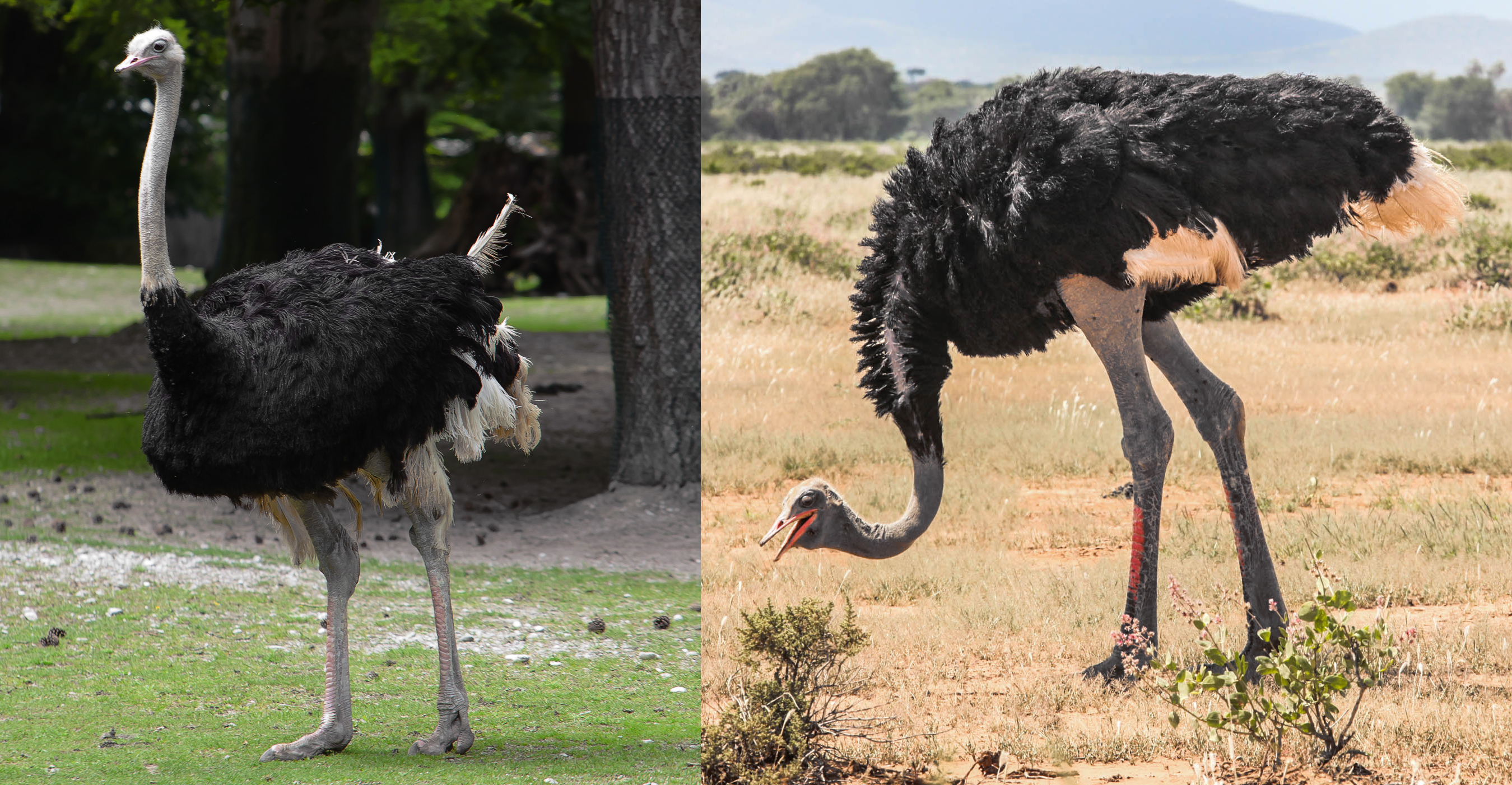
The Ostrich or Common Ostrich (Struthio camelus) is either one or two species of large flightless birds native to Africa, the only living member(s) of the genus Struthio, which is in the ratite family. Some analyses indicate that the Somali Ostrich may be better considered a full species separate from the Common Ostrich, but most taxonomists consider it to be a subspecies. The ostrich shares the order Struthioniformes with the kiwis, emus, rheas, and cassowaries. It is distinctive in its appearance, with a long neck and legs, and can run at up to about 70Â km/h, the fastest land speed of any bird. The ostrich is the largest living species of bird and lays the largest eggs of any living bird (extinct elephant birds of Madagascar and the giant moa of New Zealand laid larger eggs). The ostrich's diet consists mainly of plant matter, though it also eats invertebrates. It lives in nomadic groups of 5 to 50 birds. When threatened, the ostrich will either hide itself by lying flat against the ground, or run away. If cornered, it can attack with a kick of its powerful legs. Mating patterns differ by geographical region, but territorial males fight for a harem of two to seven females. The ostrich is farmed around the world, particularly for its feathers, which are decorative and are also used as feather dusters. Its skin is used for leather products and its meat is marketed commercially.

The Velvet Scoter (Melanitta fusca), also called a Velvet Duck or whitewing (not to be confused with the white-winged scoter), is a large sea duck, which breeds over the far north of Europe and Asia west of the Yenisey basin. A small, isolated population nests in eastern Turkey. The East Siberian and North American White-winged Scoter is sometimes considered conspecific with the Velvet Scoter, and its two constituent subspecies are then known as M. f. stejnegeri and M. f. deglandi. Velvet and White-winged Scoter, along with the Surf Scoter, are placed in the subgenus Melanitta, distinct from the subgenus Oidemia, Black and Common Scoters. It winters further south in temperate zones, Europe as far south as Great Britain, and on the Black and Caspian Sea. Small numbers reach France and northern Spain. It forms large flocks on suitable coastal waters. These are tightly packed, and the birds tend to take off together. The lined nest is built on the ground close to the sea, lakes or rivers, in woodland or tundra, and typically contains 7–9 eggs. This duck dives for crustaceans and molluscs. It is characterised by its bulky shape and large bill. It is the largest scoter at 51–58 cm. The male is all black, except for white around the eye and a white speculum. It has a bulbous yellow bill with a black base. The females are brown birds with two pale patches on each side of the head and white wing patches. The Velvet Scoter is one of the species to which the Agreement on the Conservation of African-Eurasian Migratory Waterbirds applies.
Shared flavor compounds
These compounds appear in both Ostrich and Velvet duck, giving them a molecular basis for flavor affinity, the pairing principle articulated by Francois Benzi and implemented in flavor-pairing research.
Why it works
The flavor-pairing hypothesis proposes that ingredients sharing significant aromatic compounds harmonize on the palate. Ostrich and Velvet duck overlap on 20 key compound(s), which is why classic culinary traditions, and our deterministic matching algorithm, place them together.
- Pairing computed by: pairing-compute
- Methodology: deterministic compound-overlap matching (no LLM)
- Compound data: Wikidata + Wikidata
- Part of: Living Gastronomic Intelligence graph
Ostrich and Velvet duck were also scored by an AI model trained on measured flavor compounds. 2 independent model run(s) converged on this affinity estimate.