Nopal + Cupuaçu

Nopales (for the pads) are a vegetable made from the young cladode (pad) segments of prickly pear, carefully peeled to remove the spines. These fleshy pads are flat and about hand-sized. They can be purple or green. They are particularly common in their native Mexico, where the plant is eaten commonly and regularly forms part of a variety of Mexican cuisine dishes. Farmed nopales are most often of the species Opuntia ficus-indica, although the pads of almost all Opuntia species are edible. Nopales are generally sold fresh in Mexico. In more recent years bottled, or canned versions are available mostly for export. Less often dried versions are available. Used to prepare nopalitos, they have a light, slightly tart flavor, like green beans, and a crisp, mucilaginous texture. In most recipes the mucilaginous liquid they contain is included in the cooking. They are at their most tender and juicy in the spring. Nopales are most commonly used in Mexican cuisine in dishes such as huevos con nopales, carne con nopales (meat with nopal), tacos de nopales, or simply on their own or in salads with queso panela (panela cheese). Candied nopale is called acitróne. Nopales have also grown to be an important ingredient in New Mexican cuisine and in Tejano culture (Texas).
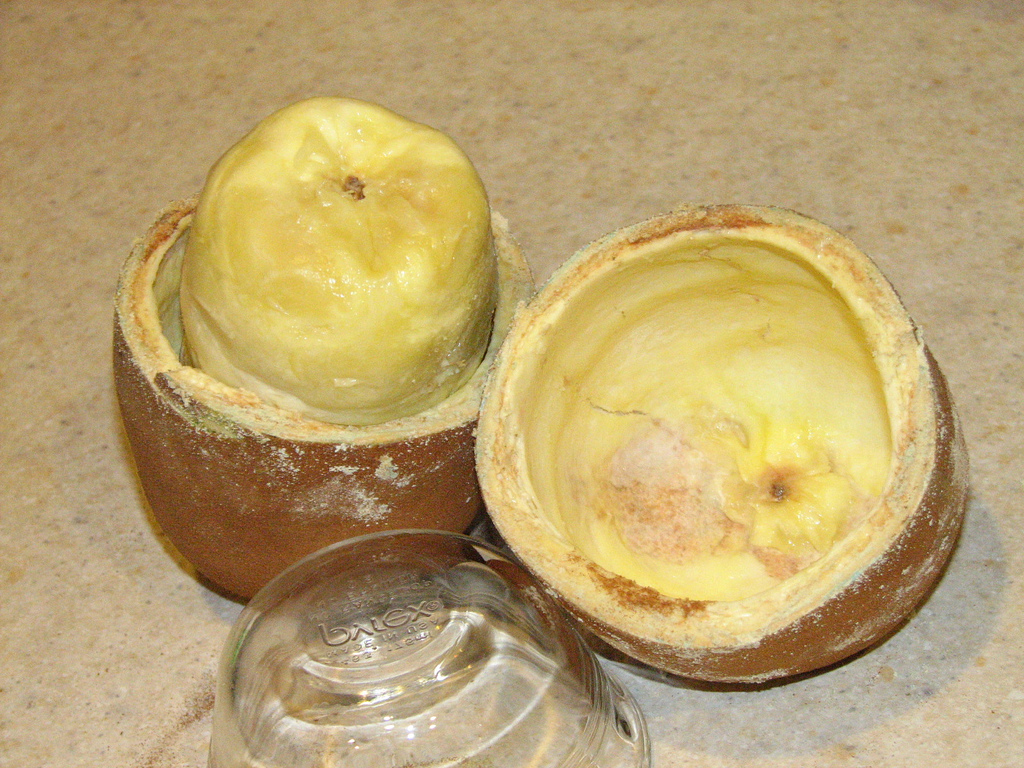
Cupuaçu (also spelled Cupuassu, Cupuazú, and Copoasu), is a tropical rainforest tree related to cacao. Common throughout the Amazon basin, it is widely cultivated in the jungles of Colombia, Bolivia and Peru and in the north of Brazil, with the largest production in Pará, followed by Amazonas, Rondônia and Acre. The white pulp of the cupuaçu is uniquely fragrant (described as a mix of chocolate and pineapple), and it contains theacrine (1,3,7,9-tetramethyluric acid) instead of the xanthines (caffeine, theobromine, and theophylline) found in cacao. It is frequently used in desserts, juices and sweets. The juice tastes primarily like a pear, with a hint of banana. [Wikipedia]
Shared flavor compounds
These compounds appear in both Nopal and Cupuaçu, giving them a molecular basis for flavor affinity, the pairing principle articulated by Francois Benzi and implemented in flavor-pairing research.
Why it works
The flavor-pairing hypothesis proposes that ingredients sharing significant aromatic compounds harmonize on the palate. Nopal and Cupuaçu overlap on 20 key compound(s), which is why classic culinary traditions, and our deterministic matching algorithm, place them together.
- Pairing computed by: pairing-compute
- Methodology: deterministic compound-overlap matching (no LLM)
- Compound data: Wikidata + Wikidata
- Part of: Living Gastronomic Intelligence graph