Mountain yam + Feijoa
Dioscorea pentaphylla is a species of flowering plant in the yam family known by the common name fiveleaf yam. It is native to tropical Asia or eastern Polynesia, and it is present elsewhere as an introduced species. This species is a prickly vine that twines counterclockwise around objects and other plants. It may reach 10 meters in length. The alternately arranged leaves are compound, divided into 3 to 5 leaflets each up to 10 centimeters long. The plant produces horseshoe-shaped bulbils about a centimeter long. New plants can sprout from the bulbils. Flowers are borne in spikes. The vine grows from a tuber. Specimens may be 3 pounds in weight and may be located over a meter underground. The tubers of the vine can be cooked and eaten.
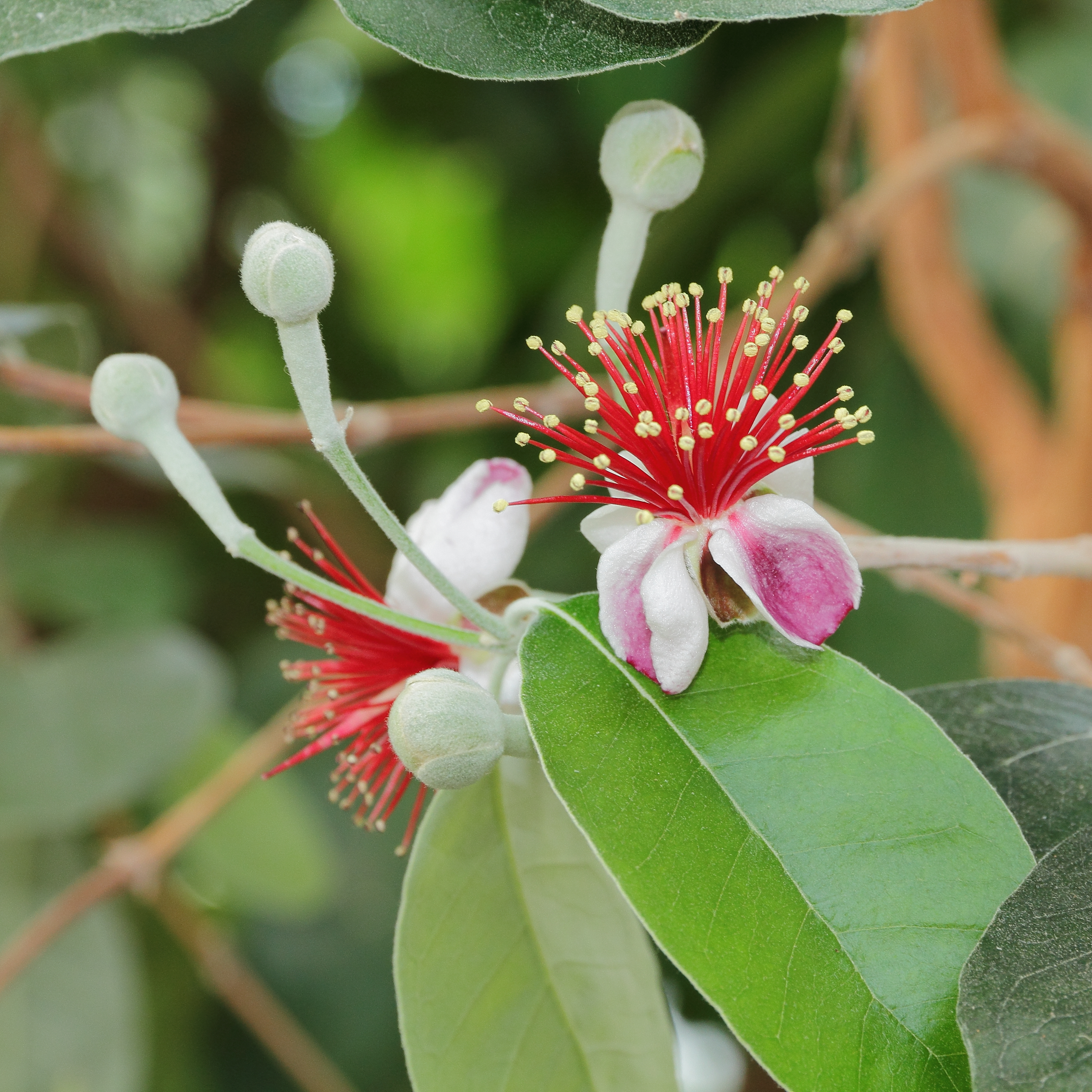
Acca sellowiana, a species of flowering plant in the myrtle family, Myrtaceae, is native to the highlands of southern Brazil, eastern Paraguay, Uruguay, northern Argentina, and Colombia. It is widely cultivated as a garden plant and fruiting tree in New Zealand, and can be found as a garden plant elsewhere such as in Australia, Azerbaijan, western Georgia and southern Russia. Common names include feijoa, pineapple guava and guavasteen. It is an evergreen, perennial shrub or small tree, 1?7 metres (3.3?23.0 ft) in height, widely cultivated as a garden plant and fruiting tree.
Shared flavor compounds
These compounds appear in both Mountain yam and Feijoa, giving them a molecular basis for flavor affinity, the pairing principle articulated by Francois Benzi and implemented in flavor-pairing research.
Why it works
The flavor-pairing hypothesis proposes that ingredients sharing significant aromatic compounds harmonize on the palate. Mountain yam and Feijoa overlap on 20 key compound(s), which is why classic culinary traditions, and our deterministic matching algorithm, place them together.
- Pairing computed by: pairing-compute
- Methodology: deterministic compound-overlap matching (no LLM)
- Compound data: Wikidata + Wikidata
- Part of: Living Gastronomic Intelligence graph