Lotus + Winged bean

Nelumbo is a genus of aquatic plants with large, showy flowers resembling the water lily, but not closely related to it. It is commonly called lotus, though this name may be applied to other genera, and there is an unrelated genus Lotus. The generic name is derived from the Sinhalese word Nelum. There are only two known living species in the genus. The sacred lotus (N. nucifera) is native to Asia, and is the better known of the two. It is commonly cultivated, and also used in Chinese medicine and cooking. This species is the national flower of India and Vietnam. The American lotus (N. lutea) is native to North America and the Caribbean. Horticultural hybrids have been produced between these two geographically separated species. A third, extinct species, N. aureavallis, is known from Eocene fossils from North Dakota, United States.
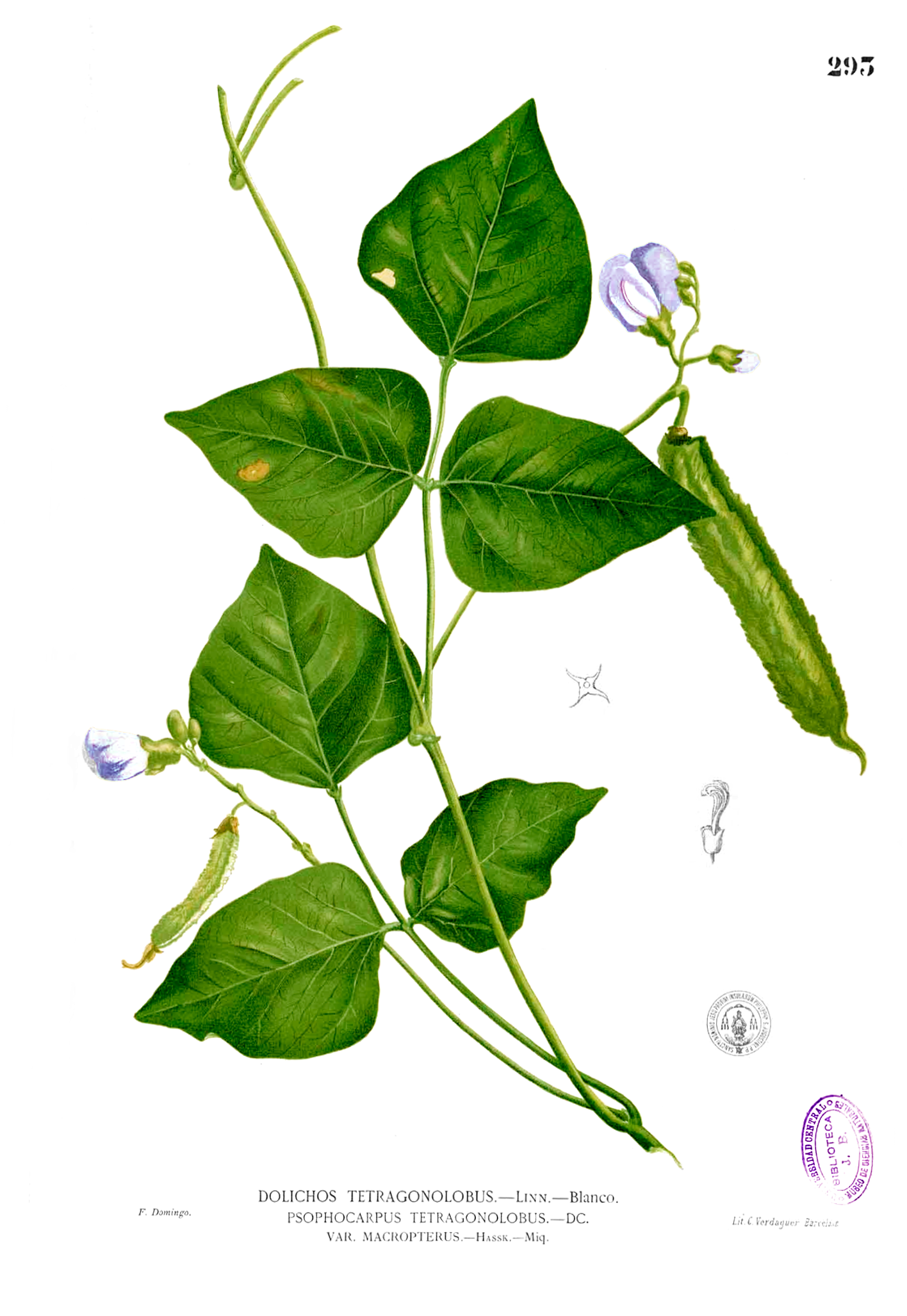
The Winged bean (Psophocarpus tetragonolobus), also known as the Goa bean and Asparagus pea, Four-angled bean and Winged pea, is a tropical legume plant native to New Guinea. It grows abundantly in hot, humid equatorial countries, from the Philippines and Indonesia to India, Burma, Thailand and Sri Lanka. It does well in humid tropics with high rainfall. There are also varieties that can be grown in most areas of the U.S.. The winged bean plant grows as a vine with climbing stems and leaves, 3–4 m in height. It is an herbaceous perennial, but can be grown as an annual. It is generally taller and notably larger than the Common bean. The bean pod is typically 15–22 cm (6–9 in) long and has four wings with frilly edges running lengthwise. The skin is waxy and the flesh partially translucent in the young pods. When the pod is fully ripe, it turns an ash-brown color and splits open to release the seeds. The large flower is a pale blue. The beans themselves are similar to soybeans in both use and nutritional content (being 29.8% to 39% protein). The plant is one of the best nitrogen fixers with nodulation accomplished by the soil bacterium Rhizobium. Because of its ability to fix nitrogen from the atmosphere, the plant requires very little or no fertilizers. Being a tropical plant, it is sensitive to frost. Most plants will not flower if the day length is more than 12 hours, meaning they will not produce pods in most temperate zones, although day length neutral cultivars do exist. The seeds have a hard coat and it helps to soak them before planting to hasten germination. The plant grows very quickly, reaching a length of four meters in a few weeks.
Shared flavor compounds
These compounds appear in both Lotus and Winged bean, giving them a molecular basis for flavor affinity, the pairing principle articulated by Francois Benzi and implemented in flavor-pairing research.
Why it works
The flavor-pairing hypothesis proposes that ingredients sharing significant aromatic compounds harmonize on the palate. Lotus and Winged bean overlap on 20 key compound(s), which is why classic culinary traditions, and our deterministic matching algorithm, place them together.
- Pairing computed by: pairing-compute
- Methodology: deterministic compound-overlap matching (no LLM)
- Compound data: PubChem CID 5851439 + Wikidata
- Part of: Living Gastronomic Intelligence graph