Capers + New Zealand spinach
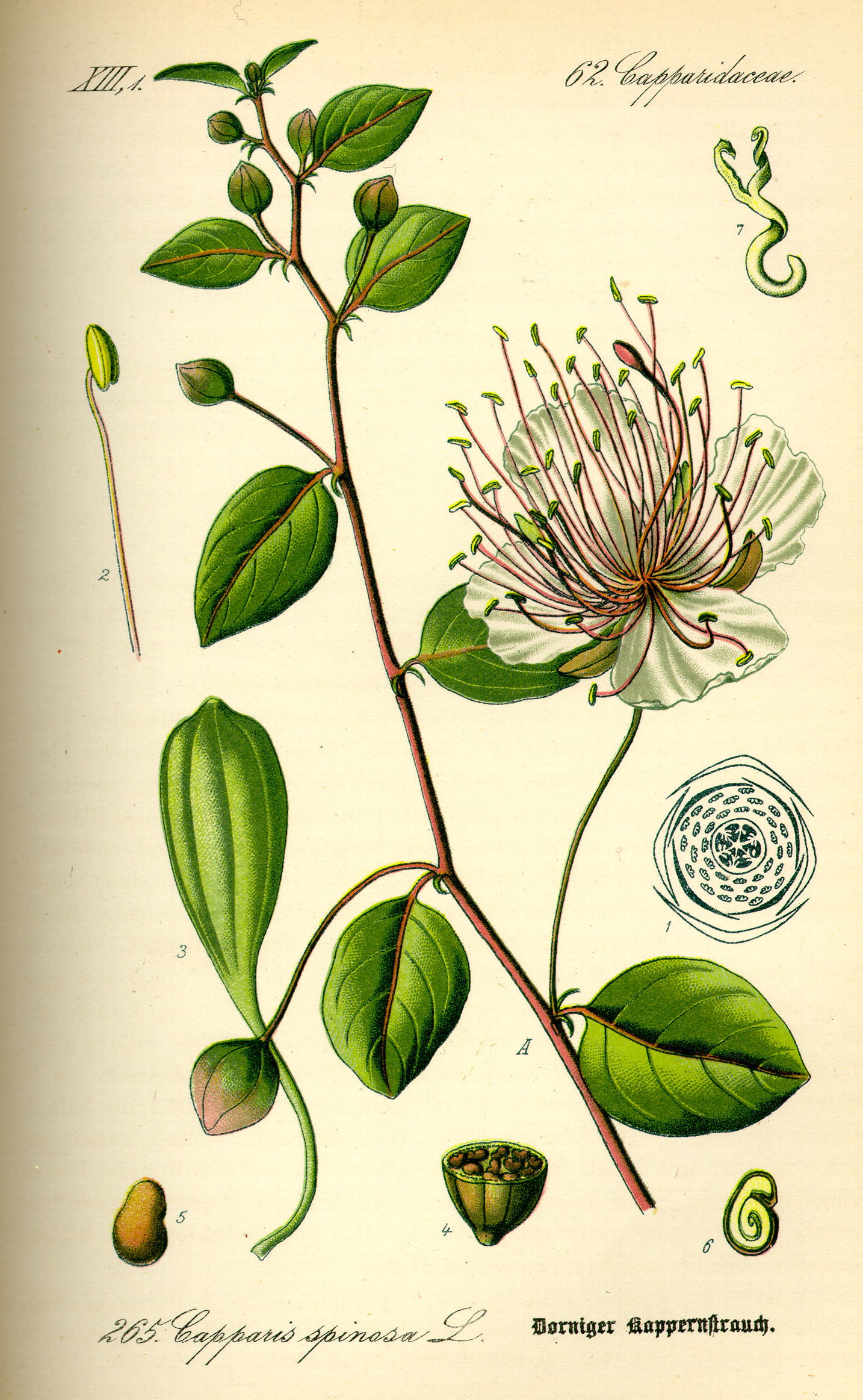
Capparis spinosa, the caper bush, also called Flinders rose, is a perennial winter-deciduous plant that bears rounded, fleshy leaves and large white to pinkish-white flowers. The plant is best known for the edible flower buds (capers), often used as a seasoning, and the fruit (caper berry), both of which are usually consumed pickled. Other species of Capparis are also picked along with C. spinosa for their buds or fruits. Other parts of Capparis plants are used in the manufacture of medicines and cosmetics.
Tetragonia tetragonioides (or previously T. expansa) is a leafy groundcover also known as New Zealand spinach, Warrigal greens, kokihi, sea spinach, Botany Bay spinach, tetragon and Cook's cabbage. It is native to New Zealand, Australia, Japan, Chile and Argentina. The species, rarely used by Maori or other indigenous people as a leaf vegetable, was first mentioned by Captain Cook. It was immediately picked, cooked, and pickled to help fight scurvy, and taken with the crew of the Endeavour. It spread when the explorer and botanist Joseph Banks took seeds back to Kew Gardens during the latter half of the 18th century. For two centuries, T. tetragonioides was the only cultivated vegetable to have originated from Australia and New Zealand. The species prefers a moist environment for growth. The plant has a trailing habit, and will form a thick carpet on the ground or climb though other vegetation and hang downwards. The leaves of the plant are 3–15 cm long, triangular in shape, and bright green. The leaves are thick, and covered with tiny papillae that look like waterdrops on the top and bottom of the leaves. The flowers of the plant are yellow, and the fruit is a small, hard pod covered with small horns. The plant is a halophyte and grows well in saline ground.
Shared flavor compounds
These compounds appear in both Capers and New Zealand spinach, giving them a molecular basis for flavor affinity, the pairing principle articulated by Francois Benzi and implemented in flavor-pairing research.
Why it works
The flavor-pairing hypothesis proposes that ingredients sharing significant aromatic compounds harmonize on the palate. Capers and New Zealand spinach overlap on 20 key compound(s), which is why classic culinary traditions, and our deterministic matching algorithm, place them together.
- Pairing computed by: pairing-compute
- Methodology: deterministic compound-overlap matching (no LLM)
- Compound data: Wikidata + Wikidata
- Part of: Living Gastronomic Intelligence graph