Horse + Velvet duck
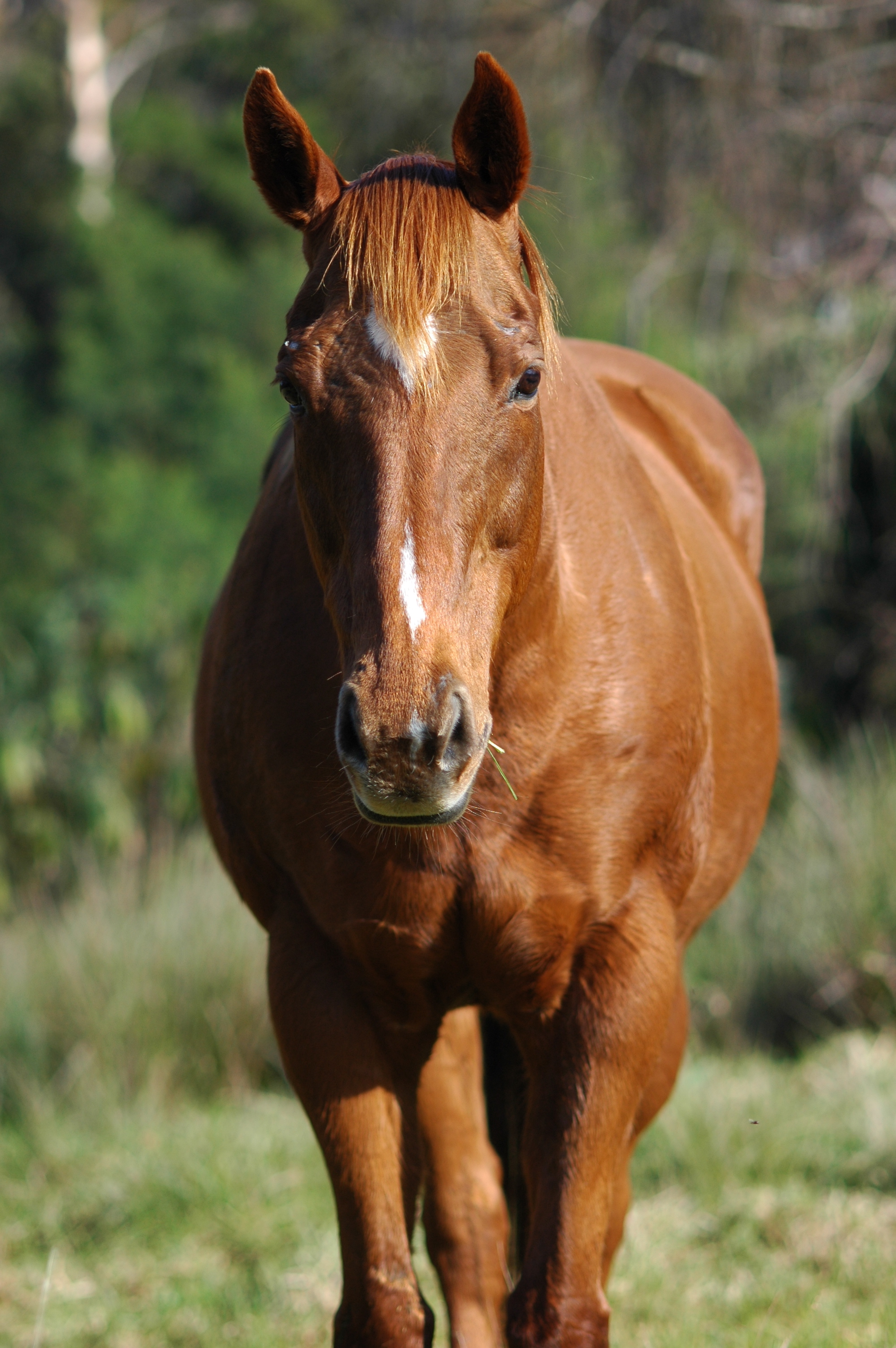
The horse (Equus ferus caballus) is one of two extant subspecies of Equus ferus. It is an odd-toed ungulate mammal belonging to the taxonomic family Equidae. The horse has evolved over the past 45 to 55 million years from a small multi-toed creature into the large, single-toed animal of today. Humans began to domesticate horses around 4000 BC, and their domestication is believed to have been widespread by 3000 BC. Horses in the subspecies caballus are domesticated, although some domesticated populations live in the wild as feral horses. These feral populations are not true wild horses, as this term is used to describe horses that have never been domesticated, such as the endangered Przewalski's horse, a separate subspecies, and the only remaining true wild horse. There is an extensive, specialized vocabulary used to describe equine-related concepts, covering everything from anatomy to life stages, size, colors, markings, breeds, locomotion, and behavior.

The Velvet Scoter (Melanitta fusca), also called a Velvet Duck or whitewing (not to be confused with the white-winged scoter), is a large sea duck, which breeds over the far north of Europe and Asia west of the Yenisey basin. A small, isolated population nests in eastern Turkey. The East Siberian and North American White-winged Scoter is sometimes considered conspecific with the Velvet Scoter, and its two constituent subspecies are then known as M. f. stejnegeri and M. f. deglandi. Velvet and White-winged Scoter, along with the Surf Scoter, are placed in the subgenus Melanitta, distinct from the subgenus Oidemia, Black and Common Scoters. It winters further south in temperate zones, Europe as far south as Great Britain, and on the Black and Caspian Sea. Small numbers reach France and northern Spain. It forms large flocks on suitable coastal waters. These are tightly packed, and the birds tend to take off together. The lined nest is built on the ground close to the sea, lakes or rivers, in woodland or tundra, and typically contains 7–9 eggs. This duck dives for crustaceans and molluscs. It is characterised by its bulky shape and large bill. It is the largest scoter at 51–58 cm. The male is all black, except for white around the eye and a white speculum. It has a bulbous yellow bill with a black base. The females are brown birds with two pale patches on each side of the head and white wing patches. The Velvet Scoter is one of the species to which the Agreement on the Conservation of African-Eurasian Migratory Waterbirds applies.
Shared flavor compounds
These compounds appear in both Horse and Velvet duck, giving them a molecular basis for flavor affinity, the pairing principle articulated by Francois Benzi and implemented in flavor-pairing research.
Why it works
The flavor-pairing hypothesis proposes that ingredients sharing significant aromatic compounds harmonize on the palate. Horse and Velvet duck overlap on 20 key compound(s), which is why classic culinary traditions, and our deterministic matching algorithm, place them together.
- Pairing computed by: pairing-compute
- Methodology: deterministic compound-overlap matching (no LLM)
- Compound data: Wikidata + Wikidata
- Part of: Living Gastronomic Intelligence graph
Horse and Velvet duck were also scored by an AI model trained on measured flavor compounds. 2 independent model run(s) converged on this affinity estimate.