Florida pompano + Whelk
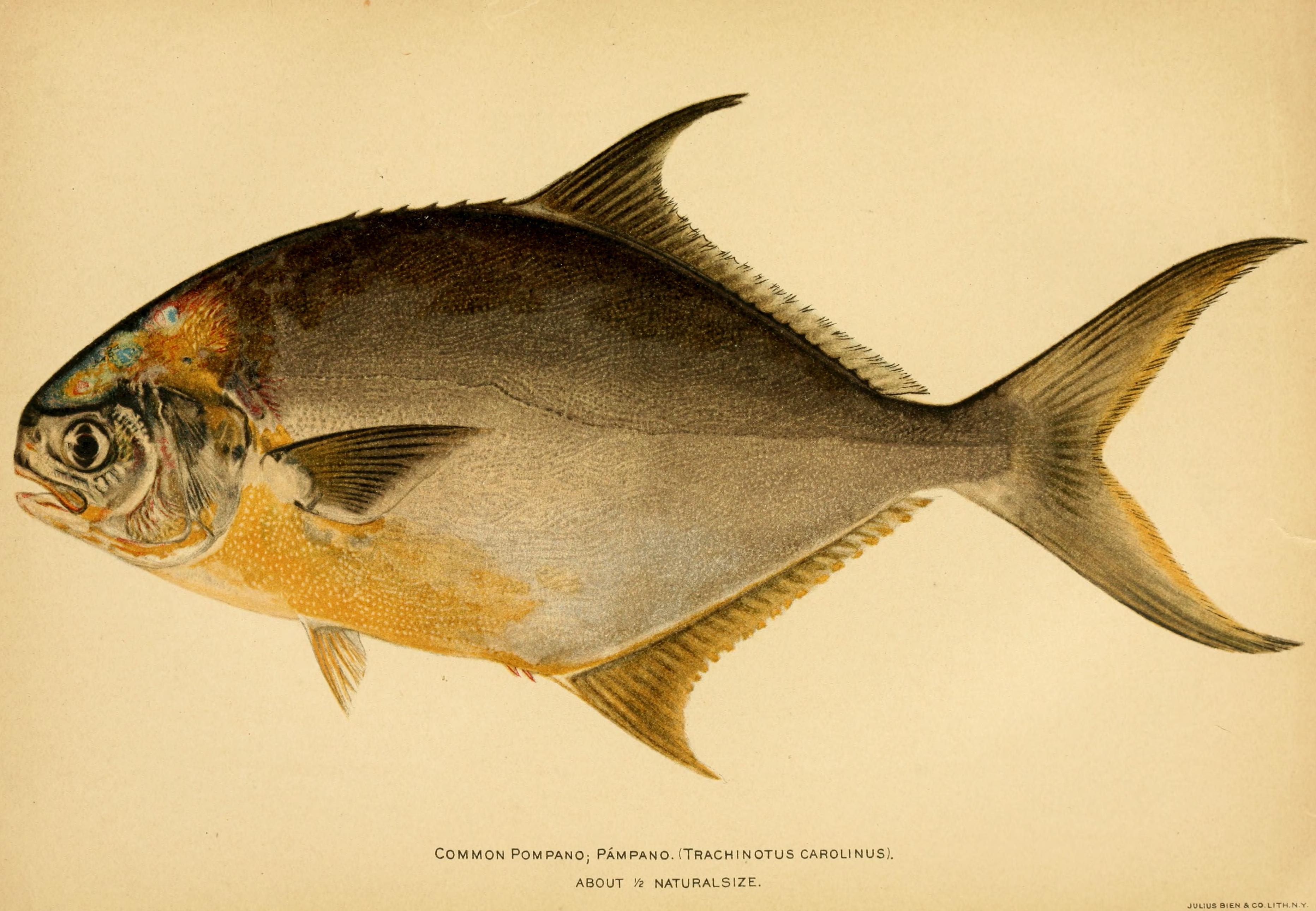
The Florida pompano (Trachinotus carolinus) is a species of marine fish in the Trachinotus genus of the Carangidae family. It has a compressed body and short snout; coloration varies from blue-greenish silver on the dorsal areas and silver to yellow on the body and fins. It can be found along the western coast of the Atlantic Ocean, depending on the season, and is popular for both sport and commercial fishing. Most Florida pompano caught weigh less than 3 pounds and are less than 17 inches long, though the largest individuals weigh 8–9 pounds ( ) and reach lengths of up to 26 inches . Because it is fast-growing and desirable for food, the pompano is one of the many fish that are currently being farmed through aquaculture. The Florida city of Pompano Beach is named after the Florida pompano.
Whelk is a common name that is applied to various kinds of sea snail, many of which have historically been used, or are still used, by humans for food. Although a number of whelks are relatively large and are in the family Buccinidae (the true whelks), the word whelk is also applied to some other marine gastropod mollusc species within several families of sea snails that are not very closely related.
Shared flavor compounds
These compounds appear in both Florida pompano and Whelk, giving them a molecular basis for flavor affinity, the pairing principle articulated by Francois Benzi and implemented in flavor-pairing research.
Why it works
The flavor-pairing hypothesis proposes that ingredients sharing significant aromatic compounds harmonize on the palate. Florida pompano and Whelk overlap on 17 key compound(s), which is why classic culinary traditions, and our deterministic matching algorithm, place them together.
- Pairing computed by: pairing-compute
- Methodology: deterministic compound-overlap matching (no LLM)
- Compound data: Wikidata + Wikidata
- Part of: Living Gastronomic Intelligence graph