Foodgeist is a participant in the Amazon Services LLC Associates Program, an affiliate advertising program designed to provide a means for sites to earn advertising fees by advertising and linking to Amazon.com. As an Amazon Associate we earn from qualifying purchases.
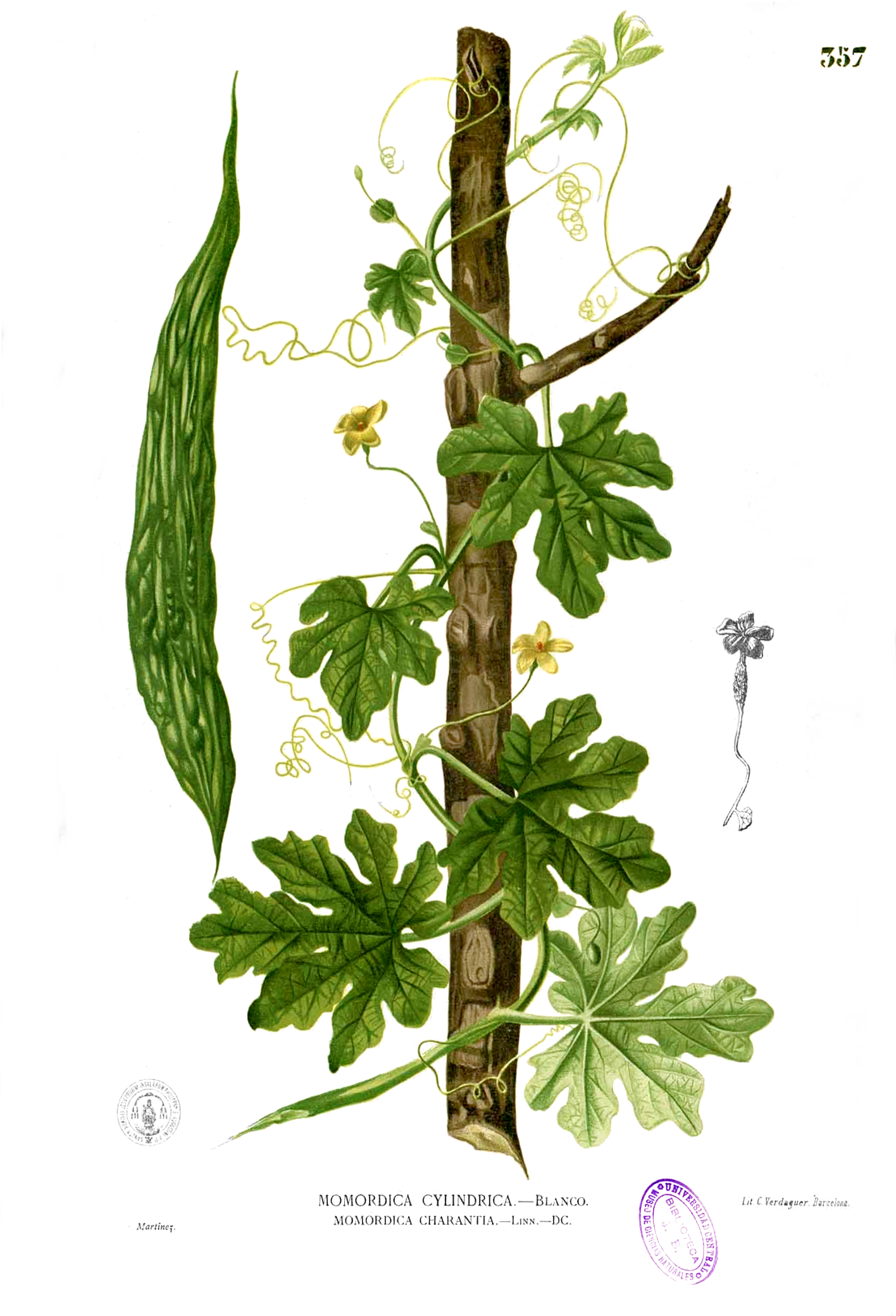
Momordica charantia often called bitter melon, bitter gourd or bitter squash in English, has many other local names. Goya from the indigenous language of Okinawa where there is a large US military presence and karavella from Sanskrit are also used by English-language speakers. It
Cook with Bitter gourd
As an Amazon Associate, Foodgeist earns from qualifying purchases.
Momordica charantia often called bitter melon, bitter gourd or bitter squash in English, has many other local names. Goya from the indigenous language of Okinawa where there is a large US military presence and karavella from Sanskrit are also used by English-language speakers. It is a tropical and subtropical vine of the family Cucurbitaceae, widely grown in Asia, Africa, and the Caribbean for its edible fruit, which is among the most bitter of all fruits. Its many varieties differ substantially in the shape and bitterness of the fruit. This is a plant of the tropics. Bitter melon originated in India, and it was carried to China in the 14th century.
Highlighted compounds are flavor-active · click to view molecular profile
Black crowberry
20 shared
Based on shared molecular compounds · click to explore
What science says
compound effect
“In vitro, the GLP-1 secretion in STC-1, a murine enteroendocrine cell line, was dose dependently stimulated by water extract (WE), its fractions (WEL, >3 kD and WES, <3 kD), and a bitter compounds-rich fraction of BG. These stimulations were partially inhibited by probenecid, a bitter taste receptor inhibitor, and by U-73122, a phospholipase C β 2 inhibitor.”
water extract of wild bitter gourd→stimulated→GLP-1 secretion
“For the bitter gourd flower, the four most abundant compounds were identified as linalool (5% of total headspace), 2-aminobenzaldehyde (27% of total headspace), 1H-indole (33% of total headspace) and methyl anthranilate (32% of total headspace), accounting for over 95% of the headspace volatiles of the flower.”
methyl anthranilate→is one of the most abundant volatile compounds→bitter gourd flower
“For the bitter gourd flower, the four most abundant compounds were identified as linalool (5% of total headspace), 2-aminobenzaldehyde (27% of total headspace), 1H-indole (33% of total headspace) and methyl anthranilate (32% of total headspace), accounting for over 95% of the headspace volatiles of the flower.”
1H-indole→is one of the most abundant volatile compounds→bitter gourd flower
“For the bitter gourd flower, the four most abundant compounds were identified as linalool (5% of total headspace), 2-aminobenzaldehyde (27% of total headspace), 1H-indole (33% of total headspace) and methyl anthranilate (32% of total headspace), accounting for over 95% of the headspace volatiles of the flower.”
2-aminobenzaldehyde→is one of the most abundant volatile compounds→bitter gourd flower
“For the bitter gourd flower, the four most abundant compounds were identified as linalool (5% of total headspace), 2-aminobenzaldehyde (27% of total headspace), 1H-indole (33% of total headspace) and methyl anthranilate (32% of total headspace), accounting for over 95% of the headspace volatiles of the flower.”
linalool→is one of the most abundant volatile compounds→bitter gourd flower