Foodgeist is a participant in the Amazon Services LLC Associates Program, an affiliate advertising program designed to provide a means for sites to earn advertising fees by advertising and linking to Amazon.com. As an Amazon Associate we earn from qualifying purchases.
The apple is the pomaceous fruit of the apple tree, species Malus domestica in the rose family. It is one of the most widely cultivated tree fruits, and the most widely known of the many members of genus Malus that are used by humans. Apples grow on small, deciduous trees. The tr
produce
Cook with Apple
As an Amazon Associate, Foodgeist earns from qualifying purchases.
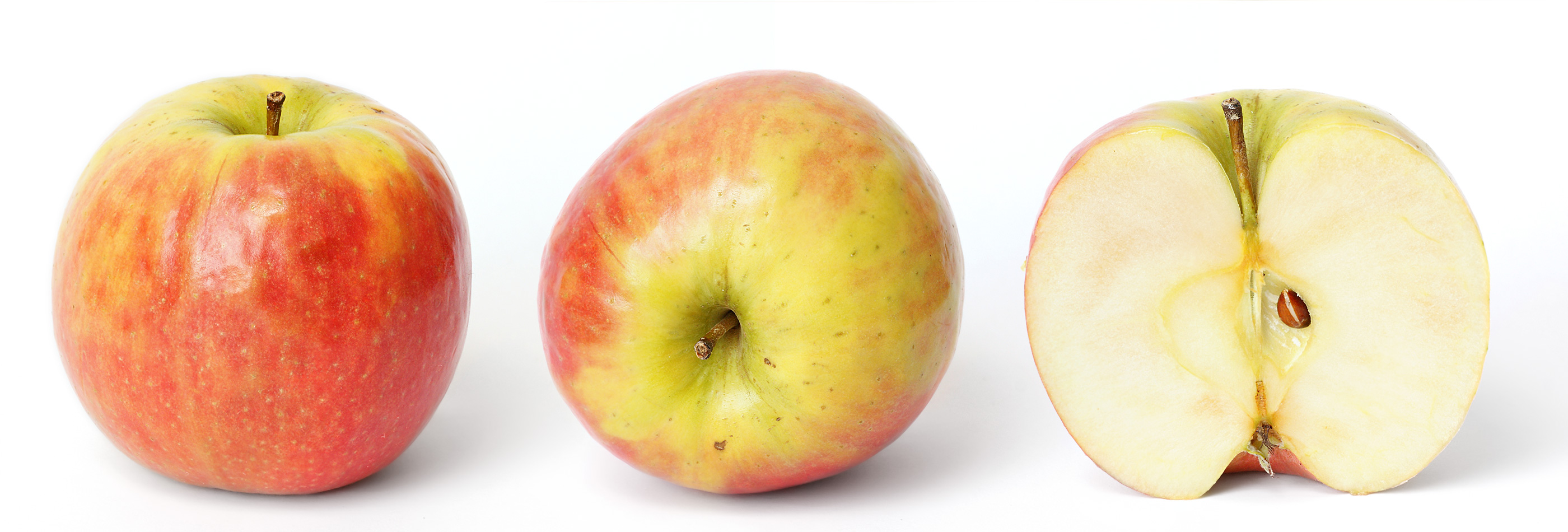
The apple is the pomaceous fruit of the apple tree, species Malus domestica in the rose family. It is one of the most widely cultivated tree fruits, and the most widely known of the many members of genus Malus that are used by humans. Apples grow on small, deciduous trees. The tree originated in Central Asia, where its wild ancestor, Malus sieversii, is still found today. Apples have been grown for thousands of years in Asia and Europe, and were brought to North America by European colonists. Apples have been present in the mythology and religions of many cultures, including Norse, Greek and Christian traditions. In 2010, the fruit's genome was decoded, leading to new understandings of disease control and selective breeding in apple production. There are more than 7,500 known cultivars of apples, resulting in a range of desired characteristics. Different cultivars are bred for various tastes and uses, including in cooking, fresh eating and cider production. Domestic apples are generally propagated by grafting, although wild apples grow readily from seed. Trees are prone to a number of fungal, bacterial and pest problems, which can be controlled by a number of organic and non-organic means. About 69 million tonnes of apples were grown worldwide in 2010, and China produced almost half of this total. The United States is the second-leading producer, with more than 6% of world production. Turkey is third, followed by Italy, India and Poland. Apples are often eaten raw, but can also be found in many prepared foods (especially desserts) and drinks. Many beneficial health effects have been found from eating apples; however, two forms of allergies are seen to various proteins found in the fruit.
Highlighted compounds are flavor-active · click to view molecular profile
Sweet orange
20 shared
Based on shared molecular compounds · click to explore
Peer-Reviewed Optimal Ranges
Range
6.5
-715
Based on 3 papers
Concentration
0%
4050600
Based on 2 papers
Drying Time
540
28050
Based on 2 papers
Microwave Power Levels
300
100385
Based on 2 papers
Sucrose Concentrations
34
2563
Based on 2 papers
Temperature
22.5°C
1530
Based on 2 papers
Temperatures
66
3450
Based on 2 papers
Thickness
7.5
12.52.6
Based on 2 papers
Value
1130.8
22601.5
Based on 2 papers
Safety thresholds
pesticide residues→ found in →apples
“significant quantities of pesticide residues have been found in many types of foods, with special attention to apples.”
residues→ below →Canadian maximum residue limit for apples
“Residues measured in this study were all below the Canadian maximum residue limit for apples.”
apple antimicrobial films→ inactivate →Campylobacter jejuni
“Apple antimicrobial films could potentially be used in retail food packaging to reduce C. jejuni commonly present on food.”
Escherichia coli O157:H7→ can be transmitted →fresh-pressed apple cider
“Fresh-pressed, unpreserved apple cider can transmit E coli O157:H7 organisms, which cause severe infections.”
unpasteurized commercial apple juice→ is considered →potentially hazardous food
“This outbreak demonstrated that unpasteurized juices must be considered a potentially hazardous food”
synbiotic apple juice→ becomes safe →for consumers
condition: after the first day of probiotic inoculationcontaminant: patulin
“In the best condition reported in this study, contaminated synbiotic apple juice by patulin will be safe for consumers after the first day of probiotic inoculation.”
Synbiotic apple juice→ is safe for consumers after →the first day of probiotic inoculation
“Synbiotic apple juice artificially contaminated with PAT will be safe for consumers after the first day of probiotic inoculation”
probiotic apple beverages and apple vinegar→ considered →safe and healthy products
“Probiotic apple beverages and apple vinegar are generally considered as safe and healthy products by the consumers.”
apple yoghurt→ prevents →mold and yeast growth
duration: 7 days
“The sample contained apple didn't have any mold and yeast; Coliforms disappeared after 7 days of storage.”
fermented apple beverages→ have →quality and safety
“available data on cider quality and safety is reviewed”
“When incorporated in a commercial antibrowning dipping solution, FreshExtend, the cinnamon bark extract (1% w/v) reduced significantly (P < 0.05) the microbial growth on apple slices stored for 12 days at 6C in comparison to the control.”
cinnamon bark extract→reduced→microbial growth on apple slices
“The most important aroma compounds in the two apple cider samples were 2-phenylethanol, butanoic acid, octanoic acid, 2-methylbutanoic acid, 2-phenylethyl acetate, ethyl 2-methylbutanoate, ethyl butanoate, ethyl hexanoate, 4-ethylguaiacol, eugenol, and 4-vinylphenol.”
butanoic acid→is an important aroma compound in→apple cider
“The most important aroma compounds in the two apple cider samples were 2-phenylethanol, butanoic acid, octanoic acid, 2-methylbutanoic acid, 2-phenylethyl acetate, ethyl 2-methylbutanoate, ethyl butanoate, ethyl hexanoate, 4-ethylguaiacol, eugenol, and 4-vinylphenol.”
octanoic acid→is an important aroma compound in→apple cider